

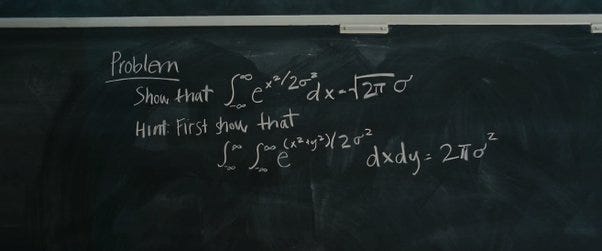
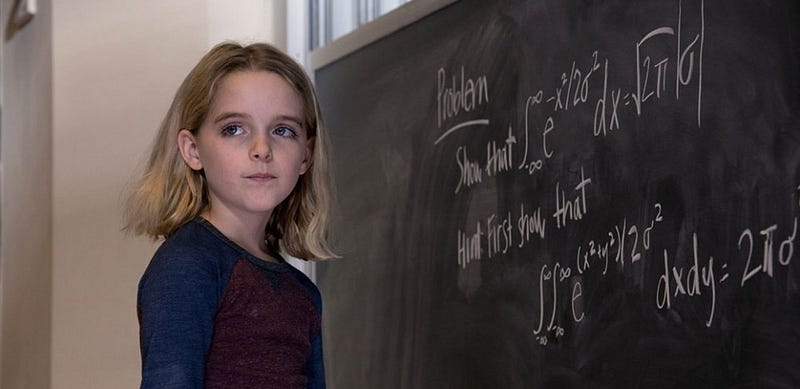
The real Math Girl Mary Adler is a fictional character from the movie ‘Gifted’. In the Gifted universe, she is a seven year-old math prodigy.
I must say I was also considered a ‘Gifted’ child by many. Gifted not because I was good at mathematics, but because I wielded the exceptional prowess of ‘舉一反三’, which literally translates to ‘learning one thing and understanding three more’. In other words, I was able to infer many thins from just one idea or example alone.
Anyway, that’s besides the point because our focus today is this problem that Mary Adler is about to solve.
For the math savants among us, I know you guys have noticed a mistake on the board. In fact, when Mary first sees the problem, she doesn’t try to solve it, rather she realizes there’s a mistake on the board. A few minutes, she gets back to the lecture hall and corrects the problem.

Yes. There’s a missing minus sign on the integral! We will go through this problem with an accessible approach so that readers of my blog can understand!
Without further ado, let’s make the problem legible!
The Gaussian Integral
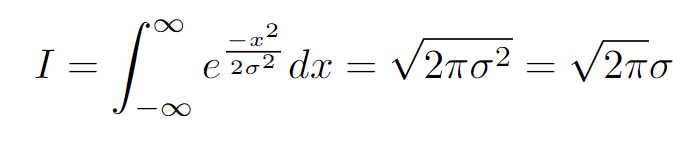
We have to prove the following result
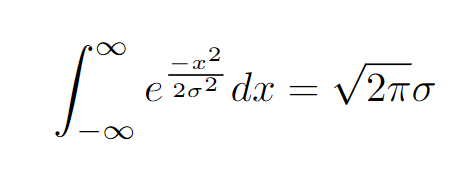
Using the hint by first showing it to be true
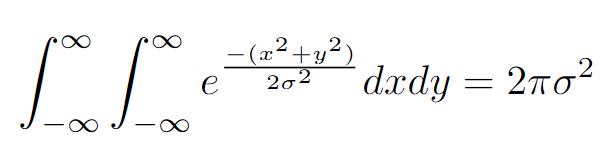
Feel free to give this problem a try before jumping in for the solution!
Solution
To make use of our hint, we will first define I as our original integral.

We will now rewrite the integral given in our hint using index laws.
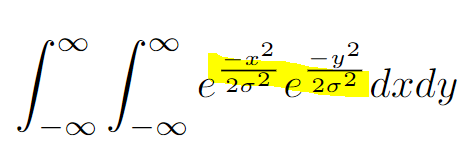
We have split the es into two terms multiplied together.
As this is a double integral, we can make use of a famous theorem known as Fubini’s Theorem. It states that if the integral of the absolute value is finite, then the order of integration does not matter.
In multivariable calculus, when we first integrate with respect to x, the term with ys is a constant, likewise, when we then integrate with respect to y, the term with xs is a constant.
Therefore, we can turn out integral into the following form.
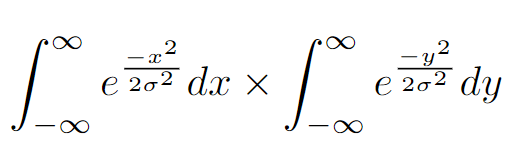
Notice this is a product of two Is as I is defined at the start.

In order to prove our answer, we simply have to find the square root of the following integral, which will give us I.
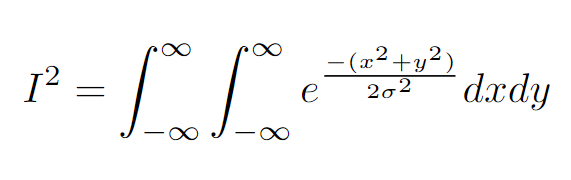
Plotting this multivariable function, we see a 3D bell-shaped curve.
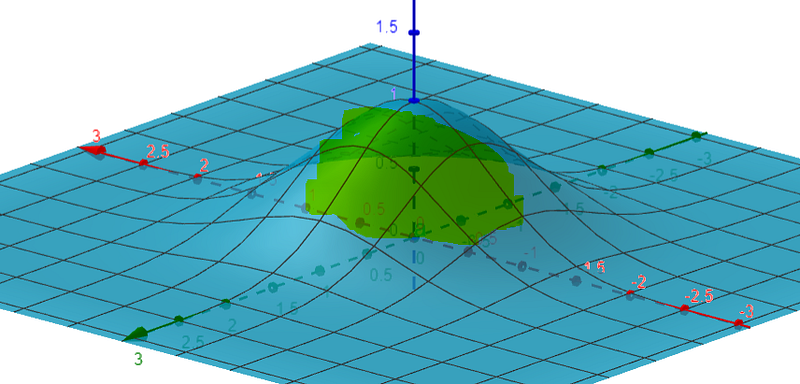
The double integral we are evaluating essentially aims at finding the volume under the curve (highlighted in yellow).
Notice x² + y² = r² is the equation of a circle. This coincides with the exponent in our function.
In fact, we can say that r is the distance a particular point is away from the z-axis on a 3D plane.
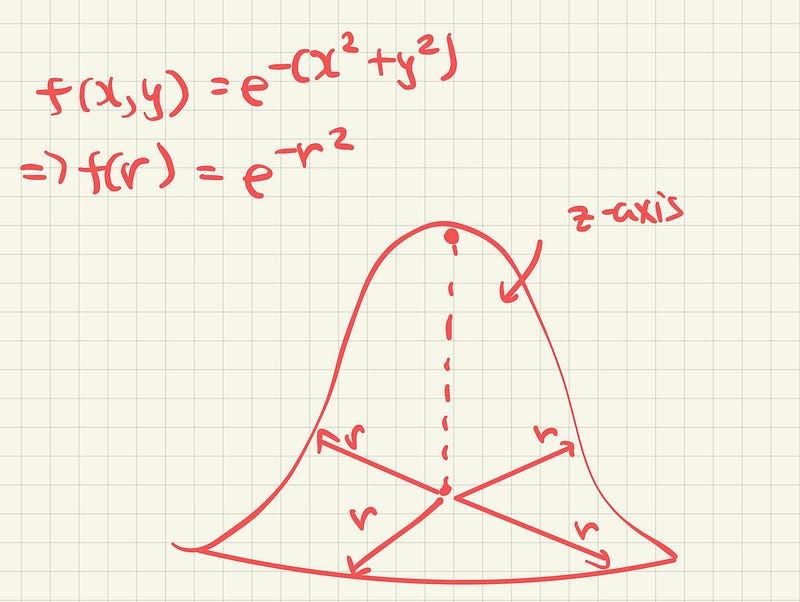
We can convert the integral to the polar form as follows

To integrate it, we will apply the following substitution.

The limits change as well because of our substitution and our integral becomes

Integrating with respect to u gives us
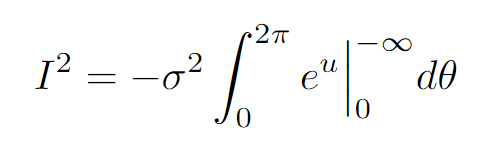
Substituting the limits, we get
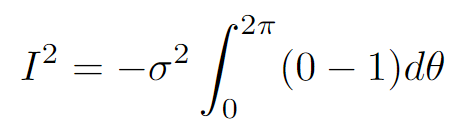
We proceed to integrate the second integral
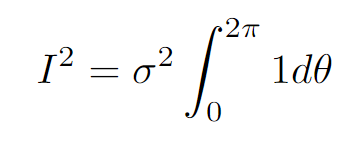
This should be simply enough that we get the answer as
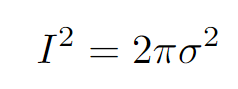
Recall we have also established that I is the answer we want to find, therefore we have proved the result!
Well done! Mary and her professor are so proud of you!

Leave a Reply