


If I were to tell you that your go-to meal at the local steakhouse has a price reduction of 600%, what would you do?
Well of course, you’d drop everything that you are doing and order as many fatty ribeye steaks served the finest fries and salads as you possibly can.
Why? Because not only are you given free food, but for every steak you order, you are compensated at a rate of five times the price of the meal.
Isn’t that too good to be true? And frankly it sounds absolutely outlandish.
According to an article from The New York Times, President Trump and members of his administration have shown that they would fail miserably in such interviews. Many administrations boast about their successes and perhaps exaggerate. But Mr. Trump and others have made quantitative claims that stretch not only the bounds of factual truth but of mathematical possibility.
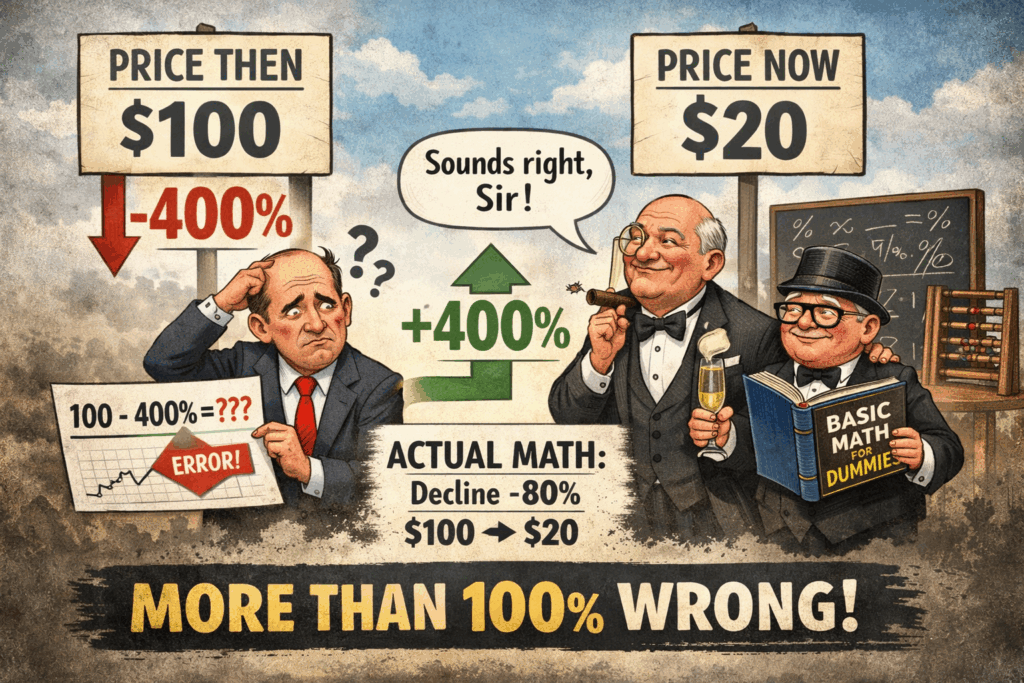
In his State of the Union address on Tuesday evening, Mr. Trump repeated a claim the administration has made before: that prescription drug prices have been reduced by as much as 600 percent, according to Harvard teaching assistant Aubrey Clayton.
There’s another absurd claim from the Trump Administration.
Mr. Trump’s Department of Homeland Security implied that it could deport 100 million people, approximately double the total number of immigrants in the entire country.
Aubrey suggested these numbers went beyond plausibly being true to being inconsistent with known mathematical axioms and definitions.
Although I must say this instance specifically does not have much to do with maths, but more so with incompetence in general within the department.
I mean how on Earth can an entire team of highly paid individuals get basic facts like that wrong?
You know I am not really political about this but yeah I do think when organizations grow in structures and complexity, their strength ultimately becomes their downfall.
Aubrey later wrote that “Mathematics education is valuable not only because it prepares people for technical jobs, but because it helps to cultivate a more basic civic capacity. Students learn that numbers impose constraints that are nonnegotiable, that definitions must be attended to carefully and that claims must yield when sufficient reasoning shows they cannot be true. The definition of a prime number is the same for me as it was for Euclid, and 2,047 will never be a prime no matter how much I desire it.”
And actually I really agree with this. One thing that a good mathematics education can impart to us is that we must treat the definitions of different concepts as precisely as possible.
The biggest takeaway one can have from proper mathematical training is not the math per se, rather the attitude and meticulousness one cultivates when learning how a mathematical proof is constructed.
Because if one can successfully apply the same rigor to critiquing phenomena we see in society, as well as concepts in the humanities, then they surely will be able to contribute meaningful insights in the political discourse, which ultimately affects everyone of us.
So I hope to be able to continue writing this blog and elucidate different confusing mathematical concepts to the general public, but also to share my 2 cents on everything that’s important to us. Everything that matters to humanity.
If you believe in our mission, consider making a contribution today.
I will be forever grateful.
Thank you.

Leave a Reply