In Robert Plomin’s Blueprint, he challenges the conventional notion that our environment influences our destiny.
One particular example that caught my eye is the bookshelf example.
- Children who grow up in homes with lots of books tend to read more. It is tempting to conclude that putting books in the home causes children to become readers.
- Parents who enjoy reading may be more likely to fill their homes with books. They also pass some of their genetic propensities to their children, who may inherit tendencies towards intellectual curiosity, verbal ability or an interest in reading.
- The bookshelf and the child’s reading habits are correlated. Yet some of that correlation may arise because the same genetic influences contribute to both the parents’ behaviour and the child’s behaviour.
Most midwit science and maths educators on the internet and sadly on Medium like to churn out feel good and politically correct articles about STEM education, of which I have perused many.
I must say with great disappointment that these people themselves lack the basic understanding of the distinction between correlation and causation.
In this article, I am going to explain to you, unequivocally, that learning maths does NOT make one a better problem solver in other areas of life.
But before that, I would like to share excerpts in Chapter Three: The Nature of Nurture of Rober Plomin’s earth shattering truth bomb.
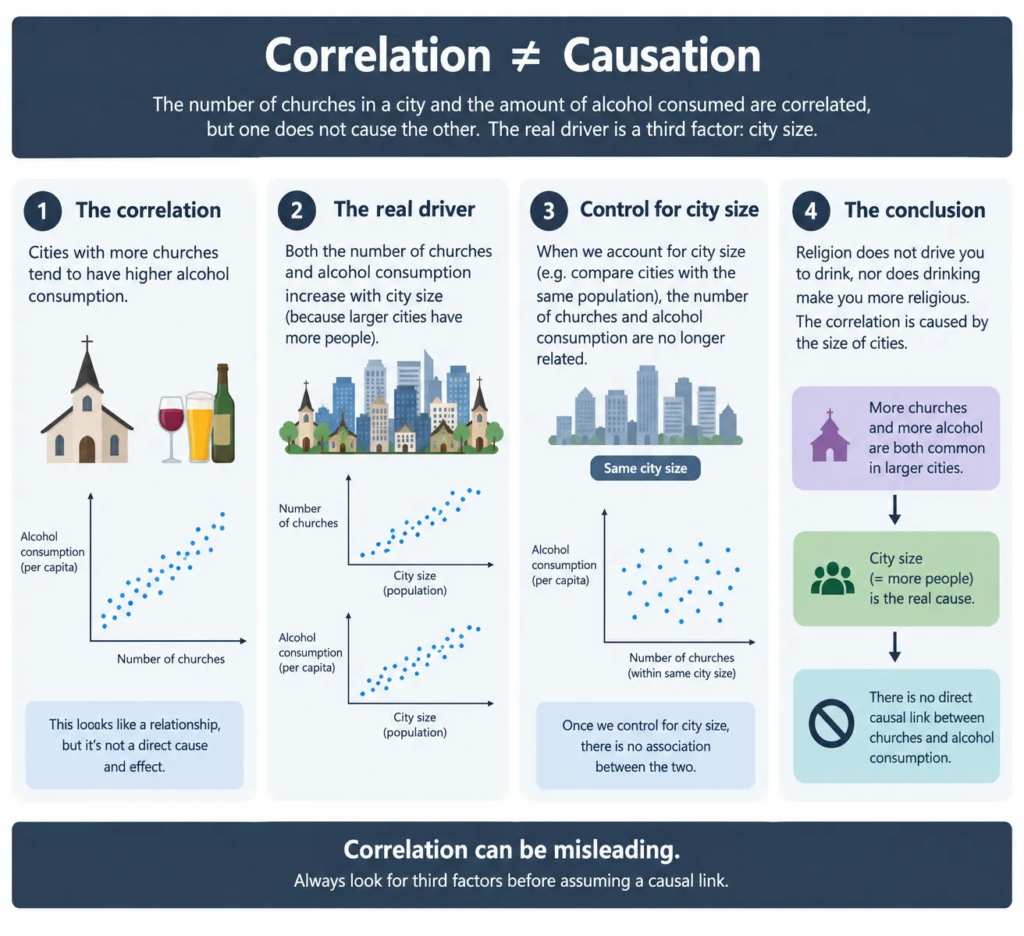
As reasonable as these causal interpretations appear to be, we should be wary of interpreting any correlation in terms of one thing causing the other. It is always possible to interpret these correlations in the opposite direction: the dictum that correlation does not imply causation. For example, rather than parents’ reading to children causing differences in how well the children read at school, how much parents read to children might reflect how much children enjoy read-ing. In addition, it is possible that neither thing causes the other. A third factor might set up the correlation between them. A classic example is the correlation between the number of churches in cities and the amount of alcohol consumed. Religion does not drive you to drink, nor does drinking make you more religious. The correlation is caused by the size of cities: because larger cities have more people, they have more churches and greater consumption of alcohol. Once you control for this third factor, there is no association between the number of churches and the amount of alcohol consumed.
Genetics could be a ‘third factor’ that contributes to the correlation between parents’ reading to their children and their children’s reading ability at school. This is what I mean by the nature of nurture.
Because parents and their children are related so per cent genetically, it is possible that genetics creates the correlation between parents who read to their children and children who are good at reading. The association could be phrased in a way that makes the possibility of genetic mediation more obvious: parents who like to read have children who like to read. Another entry point for genetics is that children who like to read or be read to might use their environment to feed their appetite for reading, for example, by asking their parents to read to them. In other words, parents might be responding to genetic differences between children in how much they enjoy reading.
What if we analysed environmental measures in a genetic design like a twin study? It seemed like a silly thing when I first did this in the 198os because environmental measures should not show any genetic influence — after all, they are environmental measures. Or are they? This was how the nature of nurture phenomenon was first discovered.
The Same Is True For Mathematics
You see, for a number of reasons, whether financial or egotistical, STEM communicators often have this grotesquely fake optimism whenever they talk about STEM. I absolutely detest it. I think these people are either ignorant or dishonest.
The logic skills used in advanced math will help with problem solving in all sorts of areas. Teaching subjects isn’t always about learning that specific thing. It’s about learning to learning, learning techniques on how to think and process information.
That’s something these mindless STEM drones will parrot without actually thinking about what they are saying.
If only they could cultivate some true critical thinking within themselves, they would soon realise that statements like that are just clichéd soundbites, and are not supported empirically.
In truth, there isn’t a lot of carry over from learning very specific cognitive skills to more general cognitive ability.
Usually, they will be quick to retort by saying something like this
Not true. The techniques in learning algebra for example. You have say 2x+y(1+2)=3y. You learn how to take the steps to solve that and it’s muscle memory for this. However you also learn how to take problems, break them into smaller sections and tackle sections individually. You practice doing that. You become used to problem solving in that manner and that can be applied to so much. Some people can’t do that (I know some) and they see a complex problem IRL and it scares them. If you sit down, break it up into smaller bits like “speak to that person, google that, ignore that for now” etc and just give them smaller steps. They manage to solve it.
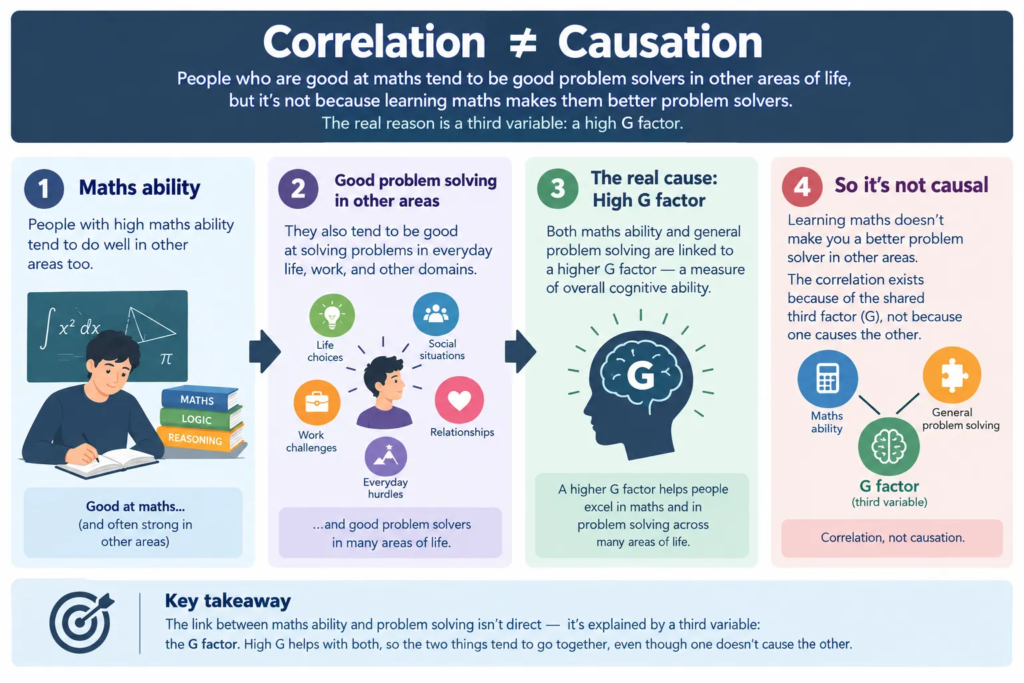
Sorry I hate to break it to you. What they are describing is a third variable, akin to a large city size having more churches and alcohol consumption.
The existence of churches doesn’t make people consume more alcohol; alcohol consumption doesn’t build more churches.
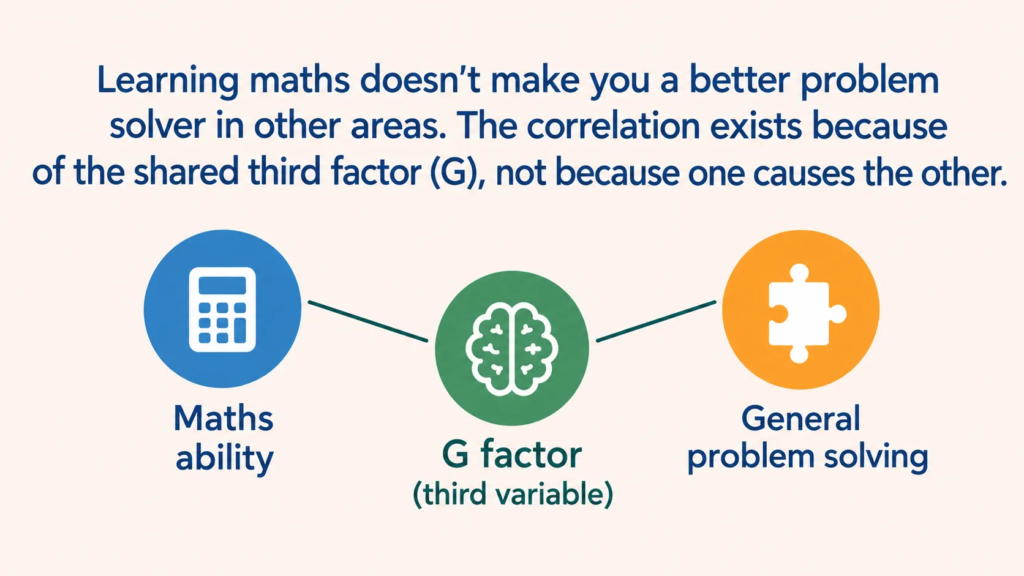
Equally for you myopic maths nerds out there, learning maths does not cultivate better problem solving or critical thinking skills; having strong critical thinking doesn’t make one good at maths.
The only true variable is a high G-factor — superior general cognitive ability.

I hope you can adjust your preconceived notions about any of this because coming from someone who has completed a 3-year maths degree, writes a successful maths blog, and has been teaching school kids maths, I can assure you with the greatest conviction that this is the closest version to reality.
Anyone that tells you otherwise is parroting politically correct hogwash.
I rest my case.
Barry