Money is not merely a measure of wealth; it is purchasing power over finite resources.
In this article I will develop a broad criticism of how the modern economy operates.
1. Money and purchasing power
Money gives individuals the ability to claim goods and services.
When someone accumulates more money, their purchasing power increases. This can influence demand, market prices and the availability of goods to others.
For example, if wealthy individuals increase their demand for housing, but the supply of housing remains relatively fixed, prices can rise. People with less purchasing power may consequently find themselves priced out.
Therefore, an individual’s accumulation of wealth can have consequences for everyone else.
Increasing someone’s monetary wealth does not necessarily increase the total amount of real resources available to society.
2. The distinction between creating wealth and capturing wealth
Economic activity can be roughly divided into two broad categories:
- Positive sum production: Creating additional real value through innovation, productivity, scientific advancement and the production of useful goods and services.
- Wealth capture: Increasing one’s share of existing economic activity, resources, consumer expenditure or market power without necessarily creating equivalent additional social value.
For example, an agricultural innovation that doubles food production creates additional real wealth.
A company that captures customers from smaller competitors might increase its own revenue without proportionately increasing society’s productive capacity.
If anything, they have destroyed the livelihoods of the everyday traders.
3. The problem of unnecessary production
Modern economies have become increasingly focused on producing things that generate revenue rather than things that meaningfully improve human welfare.
Examples include:
- Products designed to encourage unnecessary consumption.
- Advertising designed to manufacture or stimulate demand.
- Platforms designed to maximise attention and engagement.
- Businesses competing for existing consumer expenditure.
- Financial activities that generate fees without necessarily contributing equivalent productive value.
These activities can increase GDP and generate profits.
However, economic growth and improvements in human welfare are not interchangeable.
A society can generate more economic activity while experiencing greater financial insecurity, distraction, inequality and pressure on people’s time.
We may have become increasingly successful at generating economic growth without generating proportionate improvements in human prosperity.

4. The Agar.io analogy: Companies as competing blobs
Back in primary school, I remember playing this game called Agar.io after school on a Friday evening.
In the game, you start as a blob and the objective is to survive. How? By not getting eaten, and most importantly eating other players’ blobs.
I think the modern economy increasingly feels just like that.
Every company resembles a blob in Agar.io.
- It starts small.
- It competes for resources.
- It absorbs customers and market share.
- It accumulates capital.
- Its increasing size gives it advantages over smaller competitors.
- It continues expanding to become more powerful.
The interesting observation is that companies can become incentivised to pursue growth even after reaching a size that could comfortably sustain their operations.
Why? Because their competitors continue expanding.
A company that chooses to remain small and content risks being overtaken by those that pursue aggressive growth.
Growth therefore becomes a survival mechanism. It’s a dog eat dog world out there, my friend.
5. The Prisoner’s Dilemma on Steroids
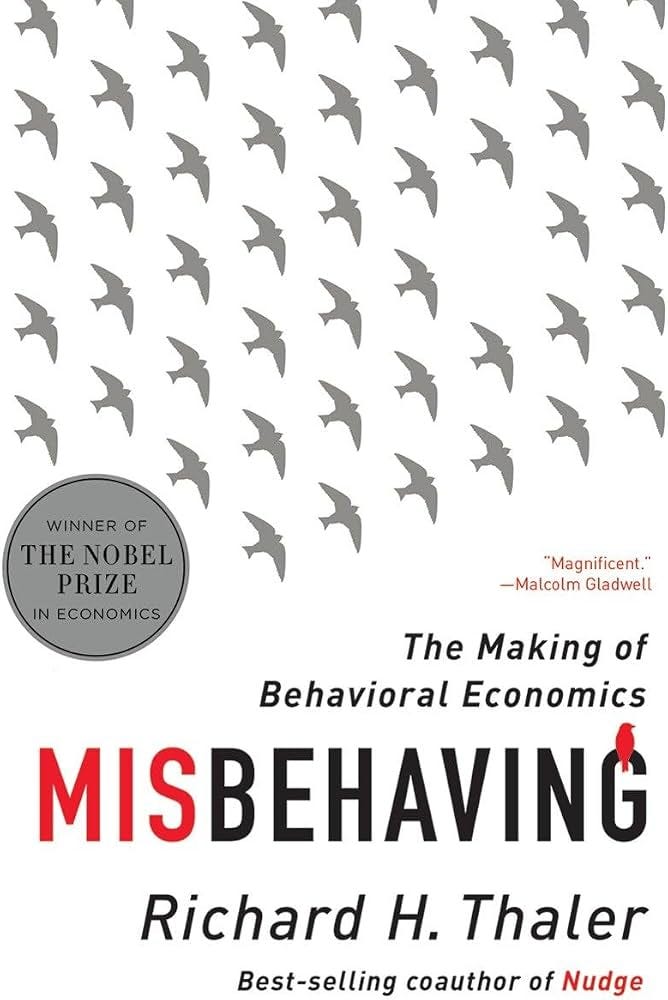
If I remember correctly, I first came across the prisoner’s dilemma in Richard Thale’s book – Misbehaving: The Making of Behavioral Economics.
Back then I thought it was a pretty cool thought experiment, and certainly a profound thing to share with my teachers and classmates, with the sole and childish aim of impressing them.
Now you can’t un-see the same dilemma in action, except we are all prisoners in this massive prison.
Two companies might collectively prefer a market in which neither needs to pursue relentless expansion.
However, if one company expands aggressively while the other remains content, the expanding company can capture the other’s customers, resources and market share.
Both companies therefore have incentives to expand, even if the collective outcome is undesirable.
Now multiply this interaction across millions of participants:
- Companies compete for customers.
- Investors demand returns.
- Employees compete for wages and opportunities.
- Consumers compete for scarce resources.
- Governments compete for investment and economic growth.
- Large companies compete for influence and market power.
Each participant responds to the incentives created by everyone else.
The result is a constantly evolving system of interconnected strategic games.
6. The emergence of systemic problems
Perhaps the most important observation is that individual participants don’t necessarily need malicious intentions for undesirable collective outcomes to emerge.
A founder might genuinely want to build a useful business. An investor might simply want a reasonable return. A consumer might simply want the best price.
Yet their individual decisions can collectively produce:
- Excessive competition.
- Resource concentration.
- Unnecessary consumption.
- Increasing market power.
- Pressure for perpetual expansion.
- Inefficient allocation of resources.
- Environmental degradation.
- Adverse health outcomes for consumers.
Think of food companies adding harmful chemicals to their products to extend their shelf life, for example. Not to mention most executives of said food companies never feed their own families the food products they sell to the masses.
So what does that say? Please pause and think.
7. The inevitable consequence: increasing chaos and societal problems
If these incentives continue unchecked, the consequences extend far beyond the business world.
As companies and individuals compete to accumulate an ever-greater share of existing resources, wealth and economic power become increasingly concentrated. Competition intensifies, essential goods become less accessible to those with limited purchasing power, and businesses devote more resources to capturing markets rather than addressing society’s fundamental needs.
Over time, these pressures can contribute to:
- Economic inequality: Wealth and purchasing power become increasingly concentrated.
- Social division: Differences in living standards and opportunities create resentment and instability.
- Resource competition: Individuals, businesses and nations compete more aggressively for finite resources.
- Consumerism: Artificial demand encourages unnecessary production and consumption.
- Market concentration: Smaller businesses struggle to compete against increasingly powerful enterprises.
- Political and institutional instability: Concentrated economic power can translate into disproportionate influence over institutions and public policy.
- Environmental degradation: The pursuit of perpetual expansion places additional pressure on natural resources and ecosystems.
These problems can reinforce one another, creating feedback loops that make the system increasingly difficult to stabilise.
The irony is that the very competition intended to generate prosperity can undermine the conditions necessary for a prosperous society.
Ultimately, an economic system that continually rewards accumulation, expansion and the capture of resources, without adequately considering their collective consequences, risks producing an increasingly unequal, unstable and chaotic society.
We may become wealthier in monetary terms while becoming poorer in the things that actually make life worthwhile.