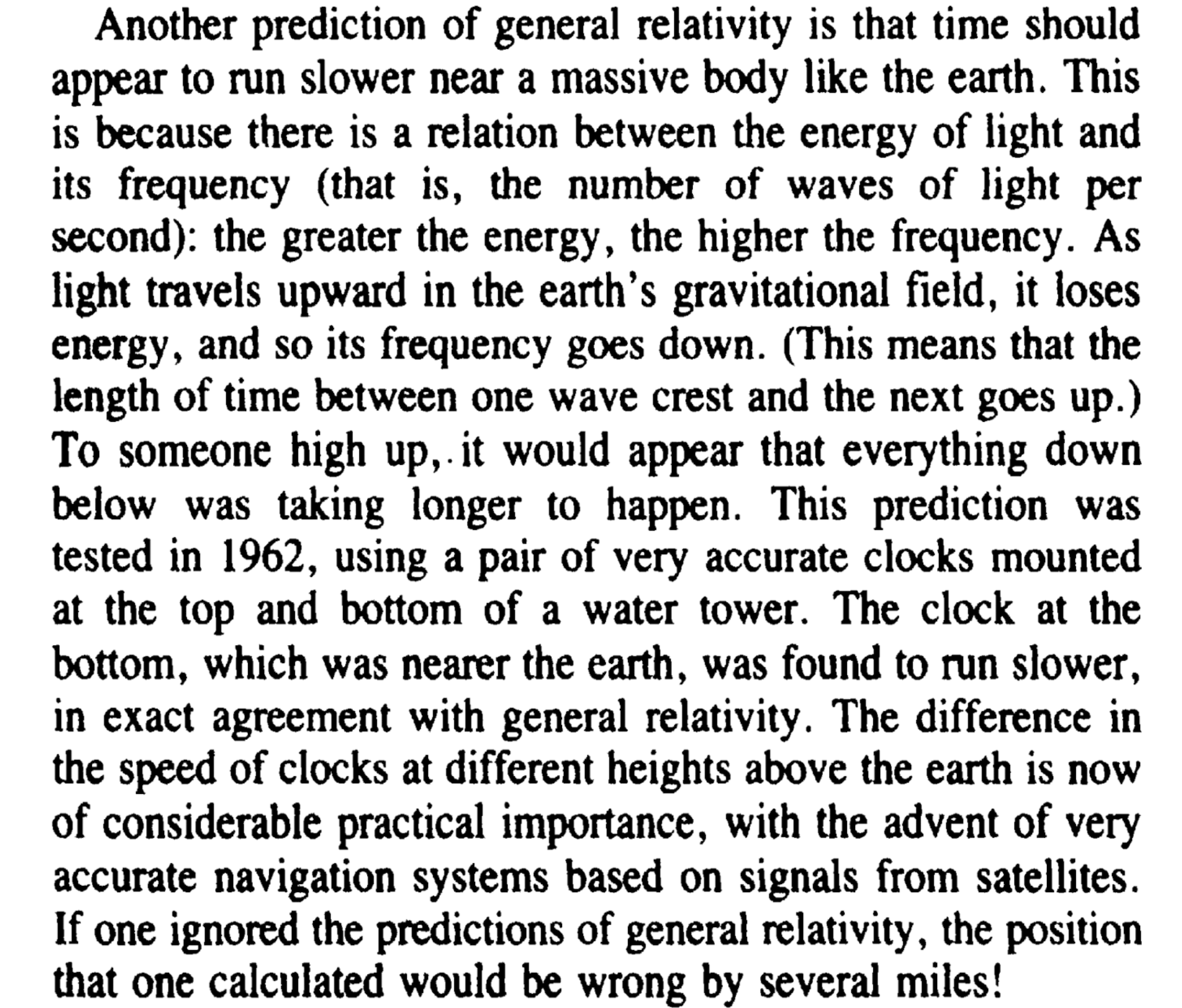
This is an excerpt from Stephen Hawking’s A Brief History of Time, which is one of the books I am currently reading.
As you can see, it talks about how things below seem to take longer to happen if we are high up on Earth. I have heard of this idea before but never had the chance to ponder about it thoroughly until recently.
Here’s my understanding of it. So there’s one person at the bottom, and another person at the top.
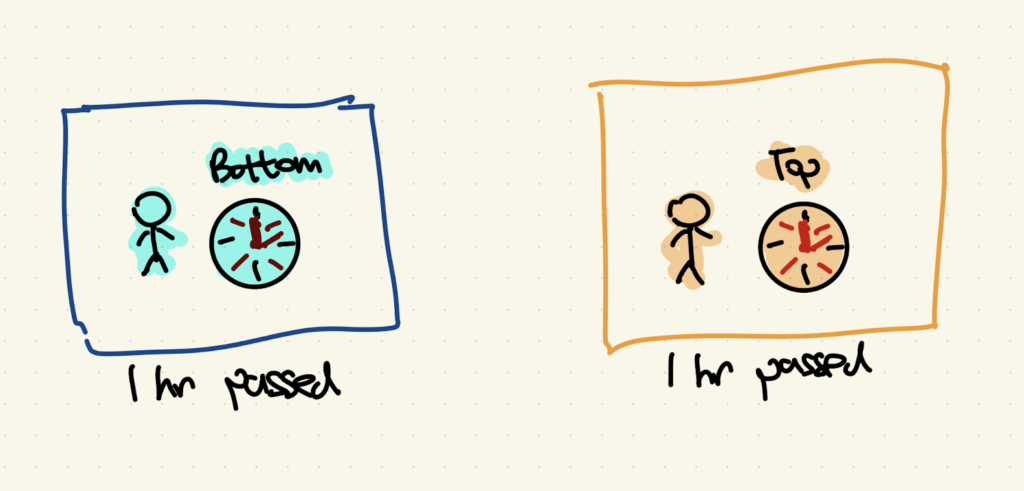
Next to each of them is their own clock. And from their frame of reference, exactly 1 hour has passed.
So the hour hand of the bottom clock has taken 1 revolution, so has that of the top clock.
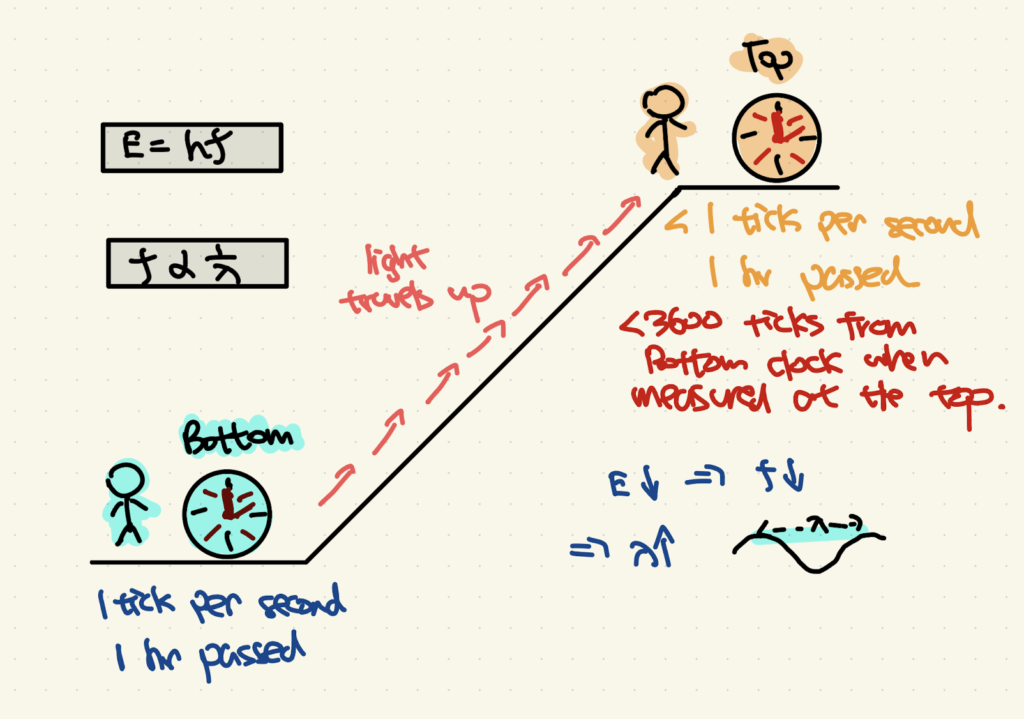
The mentioned relation between energy of light and its frequency is the equation
where E is the energy of a single photon, h is the Planck’s constant and f is the frequency of radiation.
We also know that there’s an inverse relation between the frequency and the wavelength.
In our case, we can think of the frequency of the clock as the number of ticks per second. So independently, each clock has a frequency of 1 tick per second.
Each tick of the bottom clock sends a light pulse upward, and as the light climbs, it loses energy and consequently its frequency. Thanks to the inverse relation above, the wavelength increases. This phenomenon is also known as gravitational redshift.
When each light pulse finally finishes its ascent, the frequency received by the observer at the top has decreased. In other words, using their own clock, the top observer finds that there are less than 1 tick per second.
So it seems like the bottom clock is ticking slower.

This can only mean by the time the top clock has ticked, say 3600 times, the bottom clock must have ticked less than that amount.
And we can build the symmetry case of the situation by measuring light pulses from the top to the bottom. To the bottom observer, there will be more than 3600 ticks from the light pulses by the time their own clock at the bottom has ticked 3600 times.
Fascinating, isn’t it?
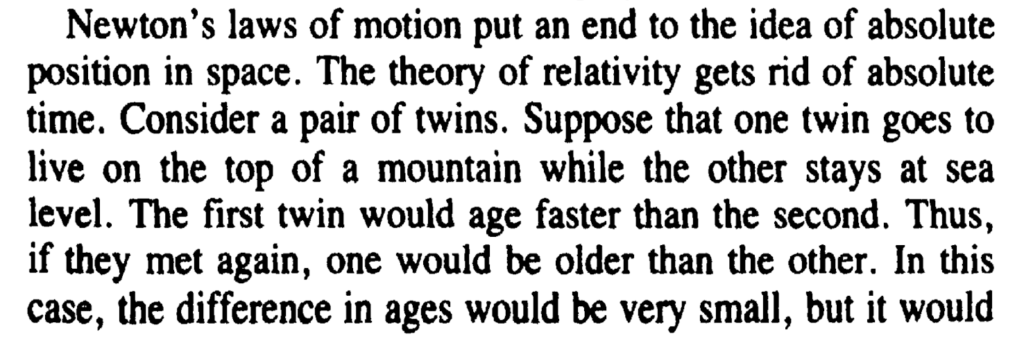
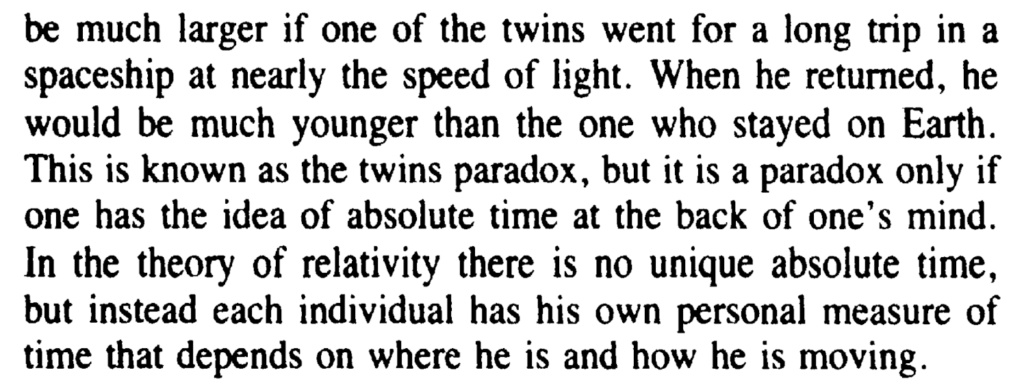
Here’s another one, which seems to go against what we have looked at. Although going higher makes you age faster, moving close to the speed of light makes you age a lot slower.
The first one is gravitational time dilation, and the one we will look at now is special relativistic time dilation. In fact, the impact of the latter dilation far outweighs the first.
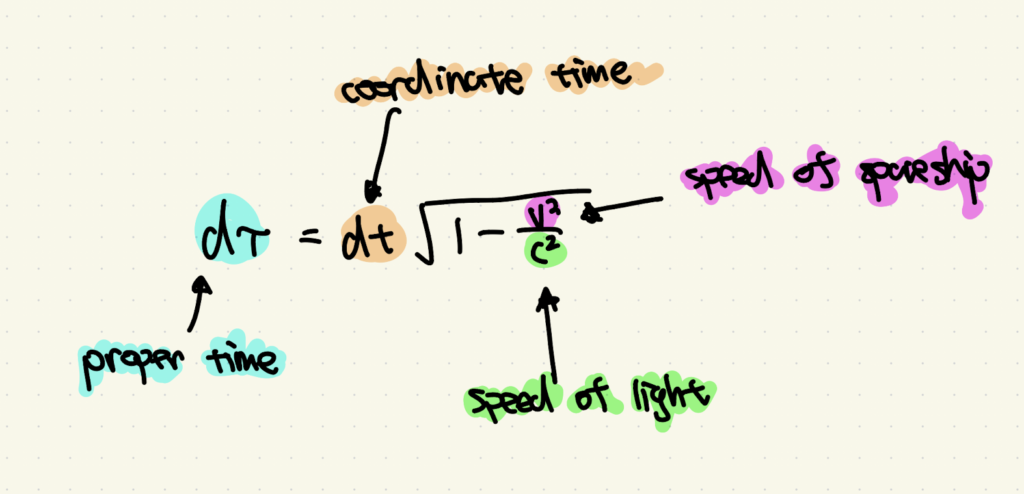
This is the time dilation formula that explains the Twins Paradox.
On the left, we have what is known as the proper time dτ, it is the time measured by a clock moving along a specific wordline. The spaceship twin has their own proper time, so does the Earth twin.
Coordinate time dt is the time assigned by a chosen inertial reference frame.
For the sake or the article, we choose the Earth frame as the inertial frame and call its time coordinate t.
In that frame, because the Earth twin is at rest, we have
For the spaceship twin that’s traveling at speed v, we have
When v = 0, that is when the spaceship is at rest, the proper time for the spaceship twin is equal to the proper time of the Earth twin.
When v = c, that is when the spaceship is traveling at exactly the speed of light, the proper time becomes zero! So the spaceship twin does not age at all in that case.
As for a value of 0 < v < c, we have
So the spaceship twin experiences less proper time than the Earth twin.
It’s important to know that for each of the twins, they experience their own time normally. Their heart beats just the way they should, their thoughts feel normal, their clock ticks once per second, and biology works in the background just as usual.
They don’t feel an internal speeding up or slowing down of time sensation.
Of course, we’d have to dig deeper if we want to understand how the equation came about, but that’s a topic for another day.
Thank you for reading. I hope you enjoyed this.
Barry, CoMN, KoMG, ARM