

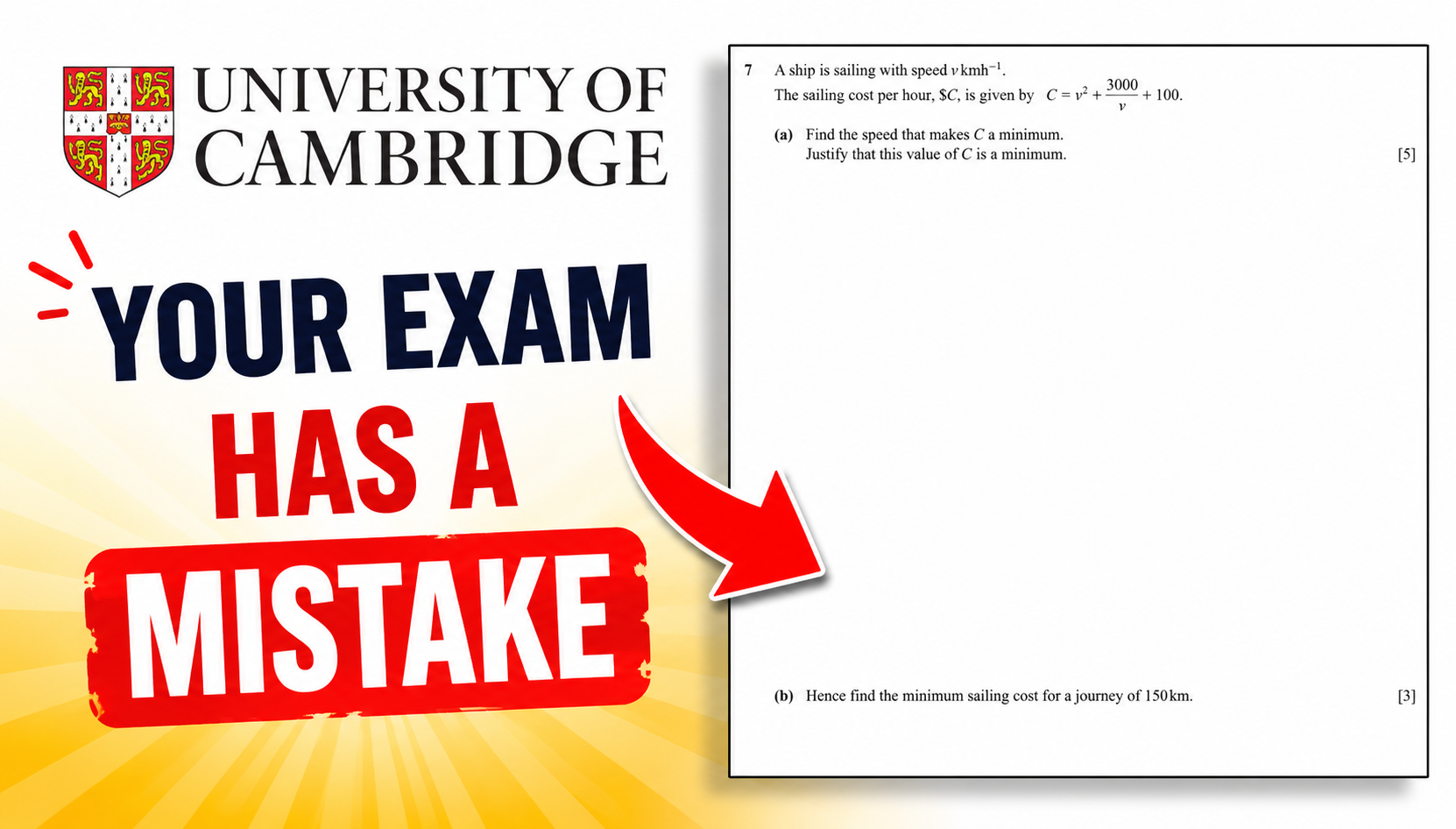
The Cambridge IGCSE is the international equivalent of England’s GCSE, a qualification typically taken by students aged 14 to 16.
Recently, a student on Reddit’s AskMath community questioned the official mark scheme for one of the exam’s questions, believing it contained an error. Many other users examined the problem and agreed that the mark scheme appeared to be incorrect.
In this article, we’ll take a closer look at the question, work through the mathematics, and explain why the official solution may be flawed.
Question:
A ship sails at a speed of v km/h. The hourly sailing cost, C, is given by
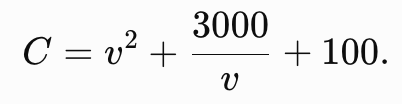
(a) Find the speed that minimises C, and justify why it s a minimum.
(b) Hence, determine the minimum sailing cost for a journey of 150 km.
I recommend you give this question a go first. And when you are done, you can keep reading to look at my solution. Finally we will look at what’s gone wrong in the original mark scheme.
Solution
The problem gives the hourly sailing cost as
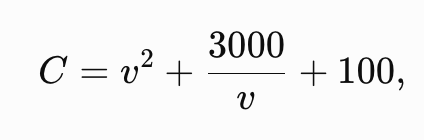
where v is the ship’s speed in km/h.
Part (a)
The first part is fairly routine. To find the speed that minimises the hourly cost, differentiate C with respect to v and set the derivative equal to zero.
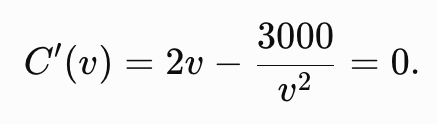
Rearranging gives
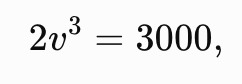
so
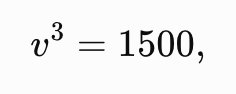
and therefore
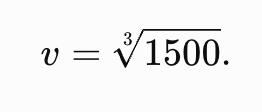
Since speed must be positive, this is the only physically meaningful solution.
To confirm that this critical point is a minimum, we apply the second derivative test. Differentiating again gives
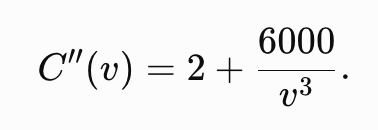
Because v > 0, both terms are positive, so
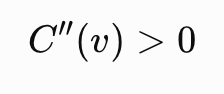
for every valid speed. Hence the stationary point at
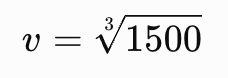
is indeed a minimum, meaning this speed minimises the hourly sailing cost.
Part (b)
The word “hence” suggests using the result from part (a). The official mark scheme substitutes the optimal speed directly into the hourly cost function:

However, this is only the cost per hour, not the total cost of the journey.
Since the journey is 150 km long, the travel time at the optimal speed is
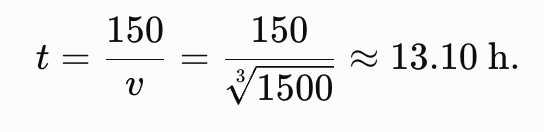
The total sailing cost is therefore

This is exactly the answer given in the official mark scheme.
But here’s the key question: does this actually represent the minimum cost of the journey?
The answer is no. The function C(v) measures the cost per hour, whereas part (b) asks for the total cost of travelling 150 km. Minimising the hourly cost does not necessarily minimise the overall cost, because the journey time also depends on the speed. To minimise the total cost, we must instead minimise
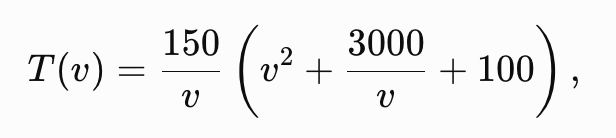
nost just C(v). This distinction is precisely where the official mark scheme goes wrong.
The Mark Scheme
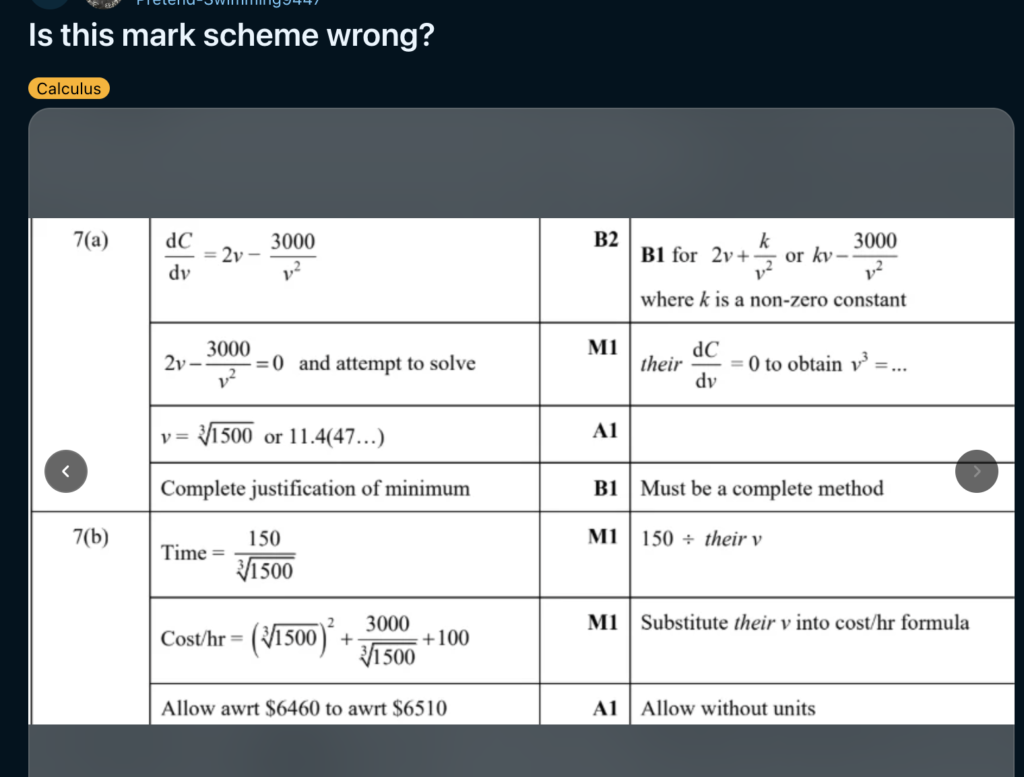
The problem with the answer is that the minimum cost per hour is not going to be the minimum cost for the distance, as faster speeds may cost more per hour but actually take less time.
For a given speed v km per hour, a 150 km trip will take:
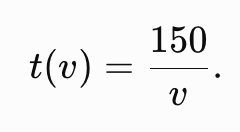
The total sailing cost is therefore

Expanding gives us
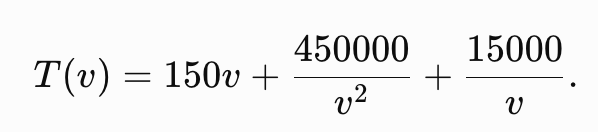
This is the function that should be minimized in part (b).
Differentiating,
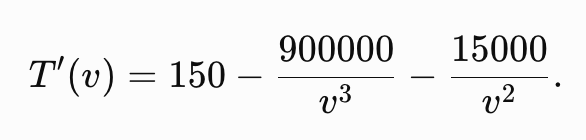
Setting the derivative equal to zero gives
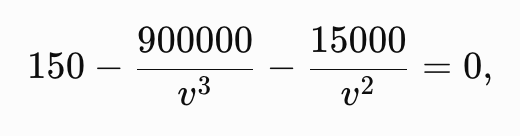
or equivalently,
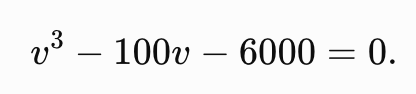
This cubic equation has only one positive real solution,
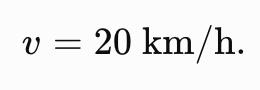
Substituting this back into the total cost function,

So the true minimum cost of the 150 km journey is
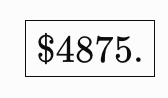
By comparison, the official mark scheme gives approximately $6462, which is over $1,500 higher than the actual minimum.
The reason is straightforward. The mark scheme minimizes the cost per hour, whereas the question asks for the minimum cost of the journey. These are different optimization problems.
In fact, travelling at the correct speed of 20 km/h costs more per hour:

compared with about $493/h at the speed found in part (a).
However, the faster speed reduces the journey time from approximately 13.1 hours to just 7.5 hours. The time saved more than offsets the higher hourly rate, resulting in a substantially lower total cost.
This appears to be the point where the exam’s mark scheme went wrong: it implicitly assumed that minimiSing the hourly cost would also minimise the total journey cost. Unfortunately, that assumption is false.
It is unclear how many students recognized this error and may have lost marks for giving the mathematically correct solution. Hopefully, the issue will be acknowledged and the mark scheme corrected.