


On July 23, 2026, at the International Congress of Mathematicians in Philadelphia, the Fields Medal went to four mathematicians. Two of them, Deng Yu and Hong Wang, share more than a stage. They share a classroom. Both entered Peking University’s School of Mathematical Sciences in 2007, and nearly two decades later they became the first Chinese nationals to win mathematics’ highest honor, in the same ceremony, for two entirely different problems that each mathematician has now closed.
This is a rare kind of moment. Fields Medals usually arrive one at a time, scattered across countries and subfields. Here we have two former classmates, each finishing off a problem that had resisted the field for over a hundred years. Deng settled a piece of Hilbert’s sixth problem, the 1900 challenge to derive the equations of fluids from the mechanics of colliding particles. Wang, working with Joshua Zahl, closed the three-dimensional Kakeya conjecture, a geometric puzzle about needles and empty space that dates to 1917. Neither result is a small technical patch. Both are foundational, the kind of theorem that other mathematicians spend the next decade building on top of.
I want to walk through what each of them actually proved, and why the mathematical community has been using words like “once in a century” to describe it.
The needle in the haystack: Hong Wang and the Kakeya conjecture
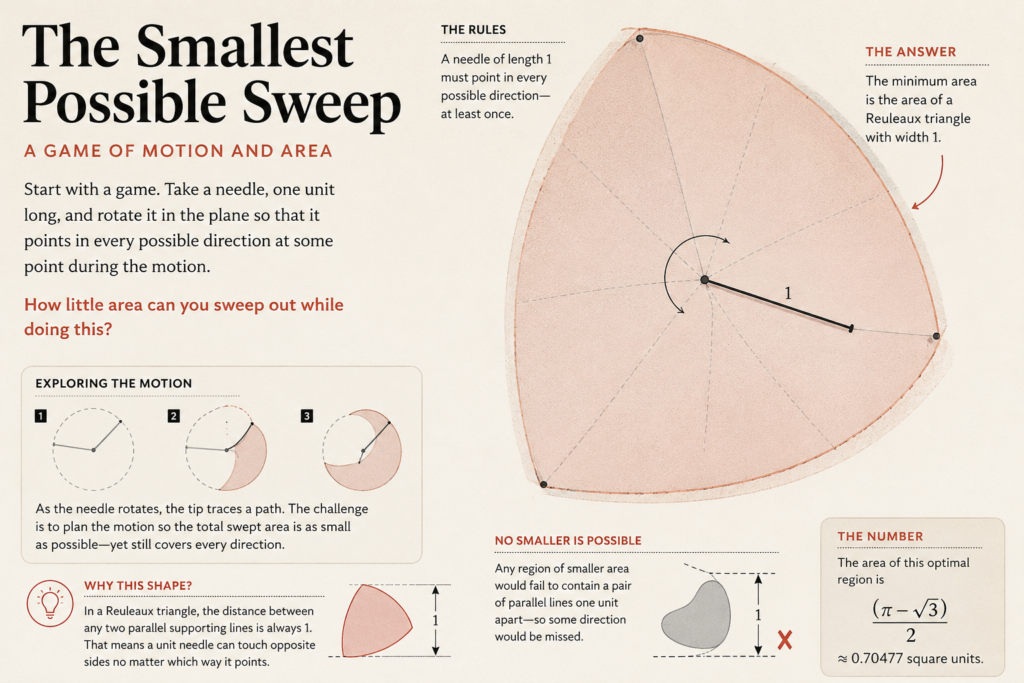
Start with a game. Take a needle, one unit long, and rotate it in the plane so that it points in every possible direction at some point during the motion. How little area can you sweep out while doing this?
Soichi Kakeya asked this question in 1917, and the surprising answer, found not long after, is that you can make the swept area as small as you like. You can rotate a needle through every direction in an area smaller than any positive number, no matter how tiny. The construction is a strange spiky shape now called a Kakeya set.
That resolved the area question, but it opened a deeper one. If a Kakeya set can have arbitrarily small area, how “thin” can it actually be, in a more refined sense than area? Mathematicians measure this thinness using fractal dimension, specifically Minkowski or Hausdorff dimension.
Formally, a Kakeya set is a set containing a unit line segment in every direction: for every unit vector , there exists a point such that
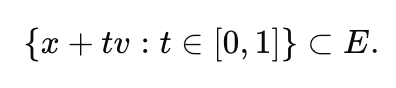
where is the set of points within distance of E.
A Kakeya set in the plane is famously known to have full dimension, , matching the dimension of the plane itself, even though its area, its 2-dimensional Lebesgue measure, can be zero. The Kakeya conjecture generalizes this statement to every dimension:

where denotes Hausdorff dimension. In words: no matter how cleverly you arrange the needle’s rotation to minimize volume, the resulting set cannot be “thinned out” in the fractal sense either. It must fill out the full n dimensions of space.
This sounds like a curiosity about needles, but it sits at the base of a tower of conjectures in harmonic analysis, the branch of mathematics that decomposes functions into waves. Above Kakeya in that tower sit the restriction conjecture, the Bochner-Riesz conjecture, and conjectures about local smoothing for the wave equation. Each of these governs how concentrated a wave or a signal can become, and each one depends on Kakeya holding true.
The restriction conjecture, for instance, asks how much a function’s Fourier transform can concentrate when the function itself is supported on a curved surface like a sphere. In its sharpest form, it predicts bounds of the shape
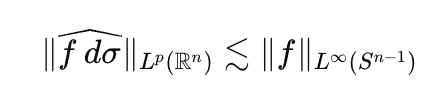
for all , where is surface measure on the sphere . Kakeya sets are exactly the geometric objects that would obstruct such a bound if they could be made too thin, which is why every known route toward restriction, Bochner-Riesz, and local smoothing passes through Kakeya first. If a counterexample to Kakeya had ever turned up, the entire tower above it would have collapsed.
The two-dimensional case has been known for decades, provable with a short argument. The three-dimensional case is where the conjecture had stood untouched since the 1970s, despite serious attempts by some of the most capable analysts alive, including Jean Bourgain and Larry Guth. In 2014, Guth proved a key structural fact: any potential counterexample to the conjecture would have to be “grainy,” meaning built from many small three-dimensional patches where a large number of the needle-like tubes overlap. That result gave later researchers a target to aim at, without telling them how to hit it.
Wang and her collaborator Joshua Zahl found the way in. Their insight was to stop tracking the full needle-shaped tubes and instead study the grains themselves, the small overlapping chunks that Guth had identified as the only possible obstruction. Counting how these grains can overlap turned out to be more tractable than counting how entire tubes can overlap.
Schematically, if is a collection of tubes in R3 pointing in -separated directions, and counts how many tubes of pass through a point , the conjecture amounts to controlling the multiplicity sum
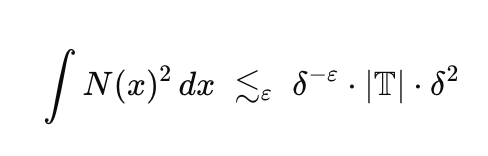
for every , which forces the union of the tubes to occupy volume close to 1 rather than collapsing onto a lower-dimensional set. Even in the worst case, where the grains are arranged to overlap as much as geometrically possible, Wang and Zahl showed the overlap sum above could not exceed this bound. Their argument also drew on a technique that Nets Katz and Terence Tao had introduced a decade earlier for a restricted class of Kakeya sets, which supplied something like a roadmap for the harder general case.
The proof itself, first circulated in early 2025, runs well over a hundred pages and required a full year of independent checking by other experts, including a detailed exposition effort led by Guth, before the mathematical community was confident it was correct. Wang has since gone on, with other collaborators, to begin reducing the next conjecture up the tower to a strengthened version of Kakeya, meaning the consequences of this proof are still being written.
Hong Wang, currently a professor at the Courant Institute of New York University and at the Institut des Hautes Études Scientifiques in France, becomes only the third woman to receive the Fields Medal.
Rebuilding fluid dynamics from billiard balls: Yu Deng and Hilbert’s sixth problem
The second story starts not with a needle but with a gas.
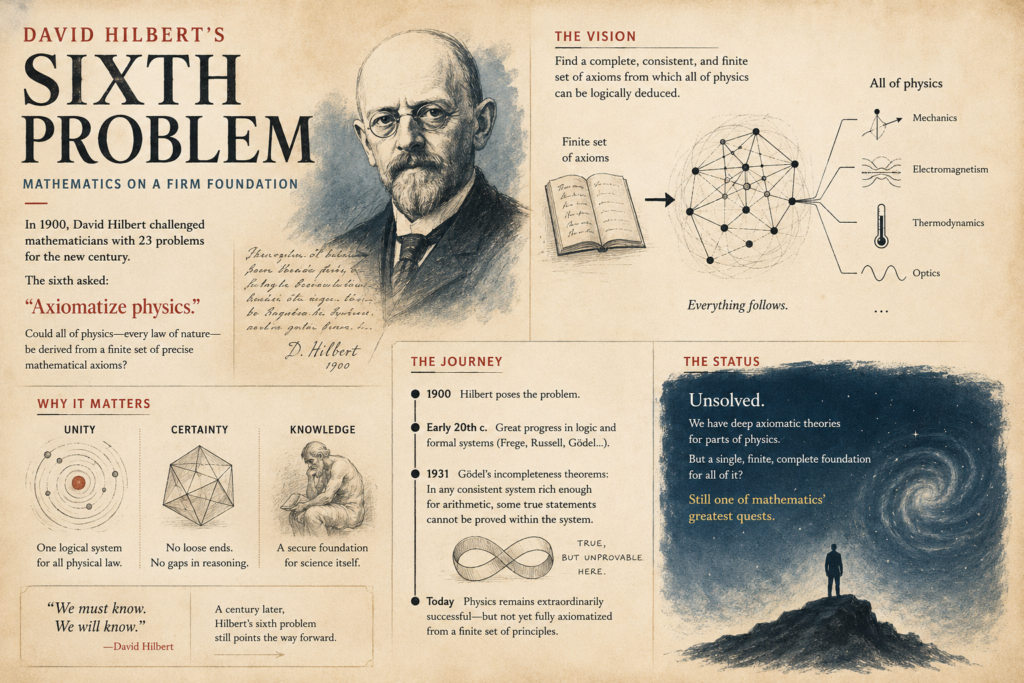
In 1900, David Hilbert posed a list of 23 problems that shaped much of twentieth-century mathematics. The sixth asked for a rigorous mathematical treatment of physics, and one specific piece of it concerns a question that sounds almost philosophical: can the smooth equations that describe fluids, equations like those governing air or water, be derived honestly from the underlying reality of countless individual particles bouncing off each other according to Newton’s laws?
This is not obvious at all. A gas is, physically, an enormous number of hard spheres colliding elastically, each one obeying nothing more than Newton’s laws. The equations engineers use to model airflow over a wing, or the equations physicists use for shockwaves, the Euler and Navier-Stokes equations, are continuous equations about density, velocity, and temperature fields, with no particles in sight.
The intermediate object bridging the two is the Boltzmann equation, which describes the evolution of a particle density over position and velocity :
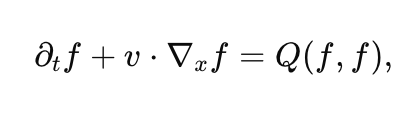
where is the collision operator, a quadratic integral term that accounts for how pairs of particles with different velocities collide and exchange momentum. Connecting this equation to the underlying system of literal colliding spheres requires the Boltzmann-Grad limit: send the number of particles and their diameter together, holding the quantity
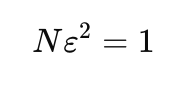
fixed, so that the expected rate of collision per particle stays constant even as any individual collision becomes vanishingly unlikely to matter. Showing that the particle system’s statistics converge to a solution of the Boltzmann equation under this limit, for a meaningful stretch of time, is the derivation Hilbert asked for.
Oscar Lanford proved in 1975 that this convergence does happen, but only for a very short window of time, a time so brief that a particle would only have experienced a small fraction of a single expected collision on average. Extending that result to the long, physically meaningful timescales on which gases actually behave like gases had remained open for fifty years. The difficulty is that a rigorous derivation must track the full statistical correlations that build up between particles as they collide repeatedly, and those correlations grow rapidly more complicated the longer you run the clock. Lanford’s method could not survive that growth.
Deng Yu, working with Zaher Hani and Xiao Ma, found a way to control it. The standard tool for this problem is the BBGKY hierarchy, an infinite chain of equations relating the k-particle correlation functions to the -particle correlation functions:
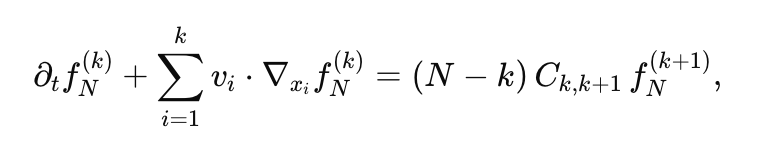
where is a collision operator linking one level of the hierarchy to the next. Lanford’s short-time proof works by expanding as a series in these correlations and showing the series converges, but only for a time so short that the series has barely begun to grow.
Deng, Hani, and Ma’s contribution is a “cumulant ansatz,” a mathematical device that keeps a memory of the entire collision history of the particles across the whole time interval , rather than trying to summarize it in a simplified snapshot the way Lanford’s expansion does. They pair this with what they describe as a time-layering argument, which breaks into structured sub-intervals, and a carefully constructed combinatorial algorithm capable of controlling the resulting sums over enormously complex collision diagrams, diagrams that would otherwise grow uncontrollably as increases. The result, announced in 2024, derives the Boltzmann equation from hard-sphere dynamics for any length of time over which the Boltzmann equation itself has a solution, which is the strongest statement one could reasonably ask for. A companion paper then connects this derivation onward to the fluid equations, completing the chain from Newton’s laws of individual collisions to the continuum equations of fluid motion, for the case of a rarefied hard-sphere gas.
The method did not appear from nowhere. Deng and Hani had already developed a version of this long-time cumulant strategy for a related problem in wave turbulence theory, the study of how energy cascades between different wavelengths in a turbulent wave field. Carrying that strategy over to a system of colliding particles, and making it work over arbitrarily long times, is the achievement being recognized.
Deng, now a professor at the University of Chicago, was also awarded the Oberwolfach Prize in 2025 for his work in analysis and applied mathematics, and the Clay Research Award in 2026 specifically for this Boltzmann equation derivation.
Two proofs, one shape
It is worth noticing what these two results have in common, beyond their authors’ shared alma mater. Both are, in their own way, about long-time behavior and accumulated complexity. Wang and Zahl had to show that geometric overlap could not accumulate past a certain point no matter how adversarially it was arranged. Deng, Hani, and Ma had to show that statistical correlation between particles could be tracked and controlled no matter how long the system evolved. Both proofs succeed by finding the right combinatorial object, grains in one case, a cumulant collision history in the other, that makes an otherwise unmanageable accumulation countable.
This is often what a genuinely hard problem in mathematics turns out to need: not a clever trick applied once, but a new unit of bookkeeping, precise enough that decades of accumulated complexity finally becomes something you can add up.
Terence Tao’s collaborator Nets Katz remarked that Wang’s paper does not need any promotion, because the achievement speaks for itself. Shing-Tung Yau, reflecting on the news, called it the fulfillment of a decades-long ambition within the Chinese mathematics community, one that both Deng and Wang, as 2007 classmates, have now delivered together. Whatever comes next for either of them, the tower each was working beneath is a little shorter today, and a little easier for the rest of us to climb.