
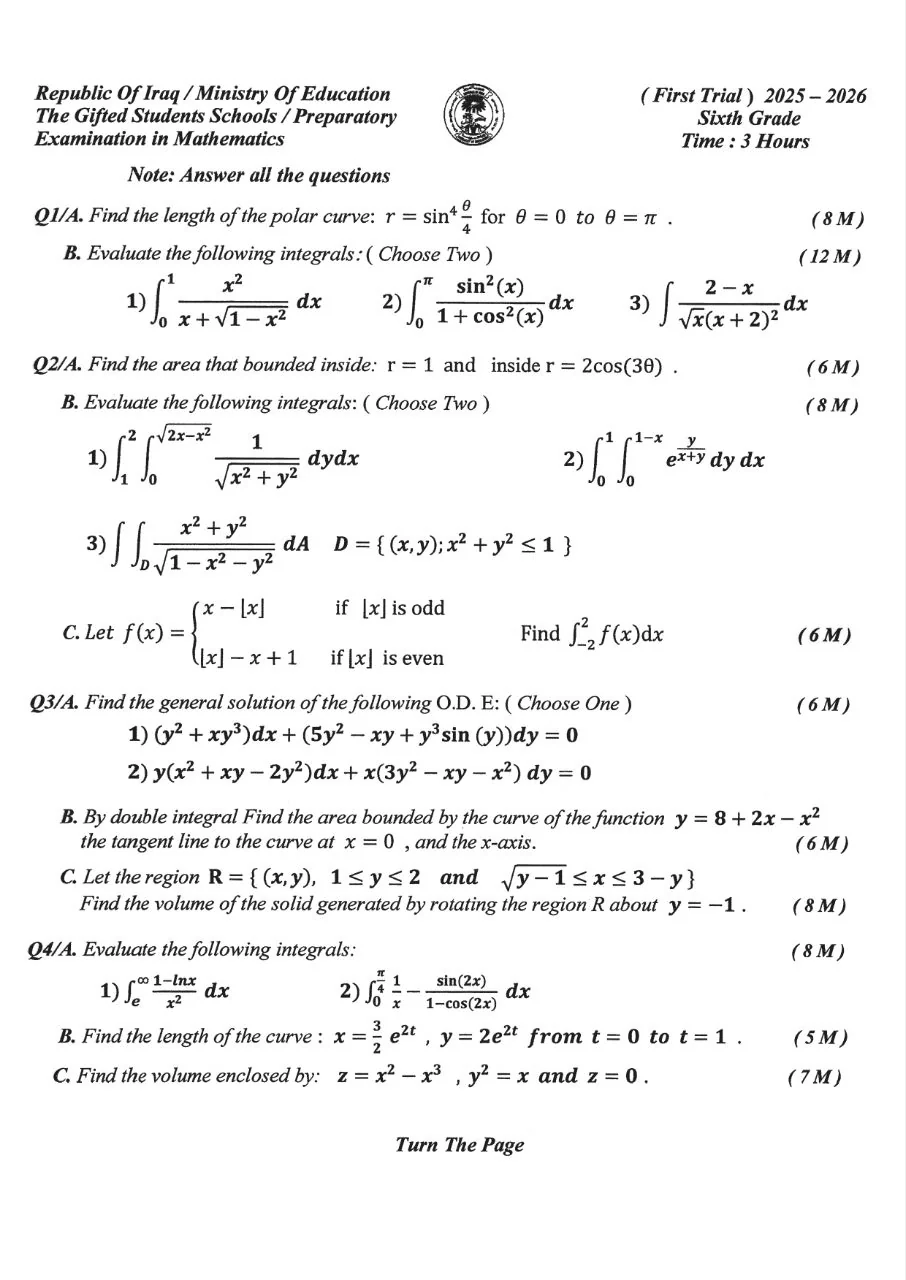
I was scrolling on Reddit today and came across this difficult maths exam from Iraqi High School for gifted students.
As someone who has completed a 3-year undergraduate degree in mathematics, I’d say similar problems also appeared on my first year exams in multivariable calculus and differential equations.
Somehow it’s more ‘satisfying’ to do calculus-based questions than proof questions in algebra or topology. Perhaps part of it is that there are more numbers than words in these questions, closer to our notions of maths as a subject in school.
Does that make sense?
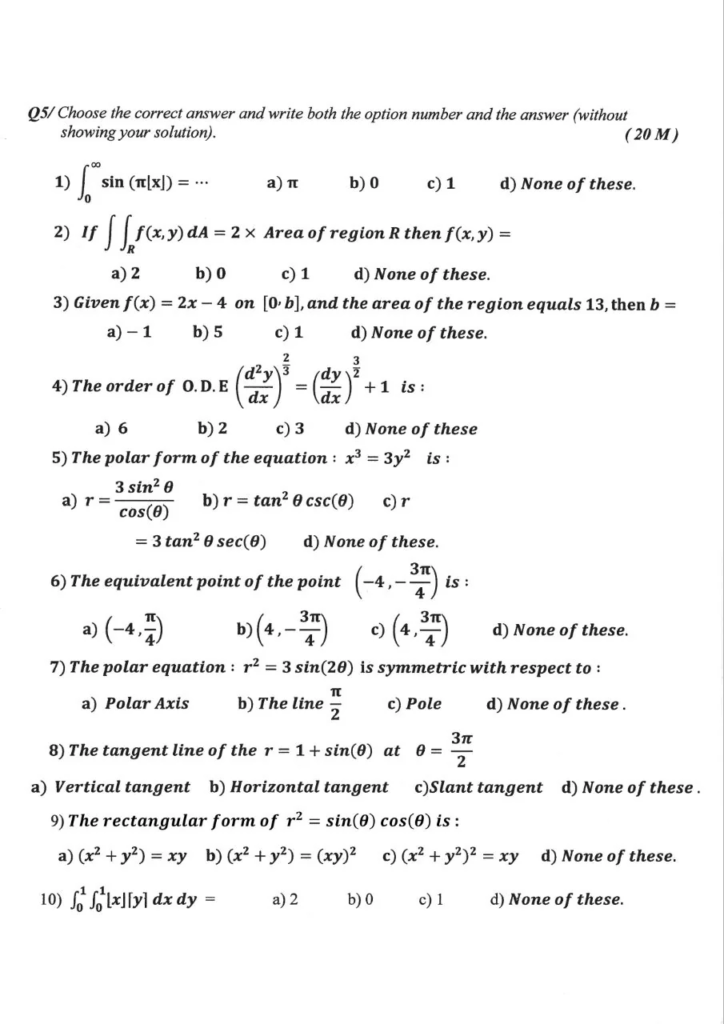
Oh and here’s the second page.
The Problem
What caught my eye most is the following double integral. And I thought it’d be a good idea to go through it together today.

Before we can solve the integral, we need to understand what the problem is actually asking.
At first glance, this looks like a wall of notation, but each part has a simple meaning.
The symbol
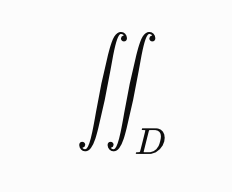
is called a double integral. While an ordinary integral adds up quantities along a line, a double integral adds up quantities spread across an entire two-dimensional region. You can think of it as dividing a surface into millions of tiny pieces, computing a value on each tiny piece, and then adding them all together.
The tiny piece of area is represented by
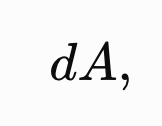
which literally means an infinitesimal patch of area. In Cartesian coordinates, this is just a tiny rectangle,
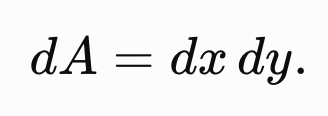
The subscript tells us where these tiny patches are located. It is the region over which we perform the summation.
In this problem,

This notation is read as:
The set of all points (x, y) whose distance from the origin is less than or equal to 1.
To see why, recall that the distance from the origin is
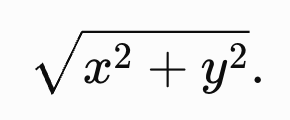
Squaring both sides gives us
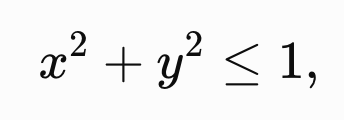
which is precisely the equation of the unit disk.
So is simply the filled-in circle of radius 1 centred at the origin.
This is perhaps the most important observation in the entire problem. The region isn’t an arbitrary shape, but a perfect circle.
Whenever a problem involves circles and expressions like
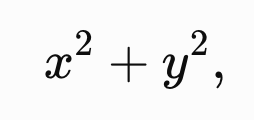
it is usually a strong hint that polar coordinates will dramatically simplify the computation.
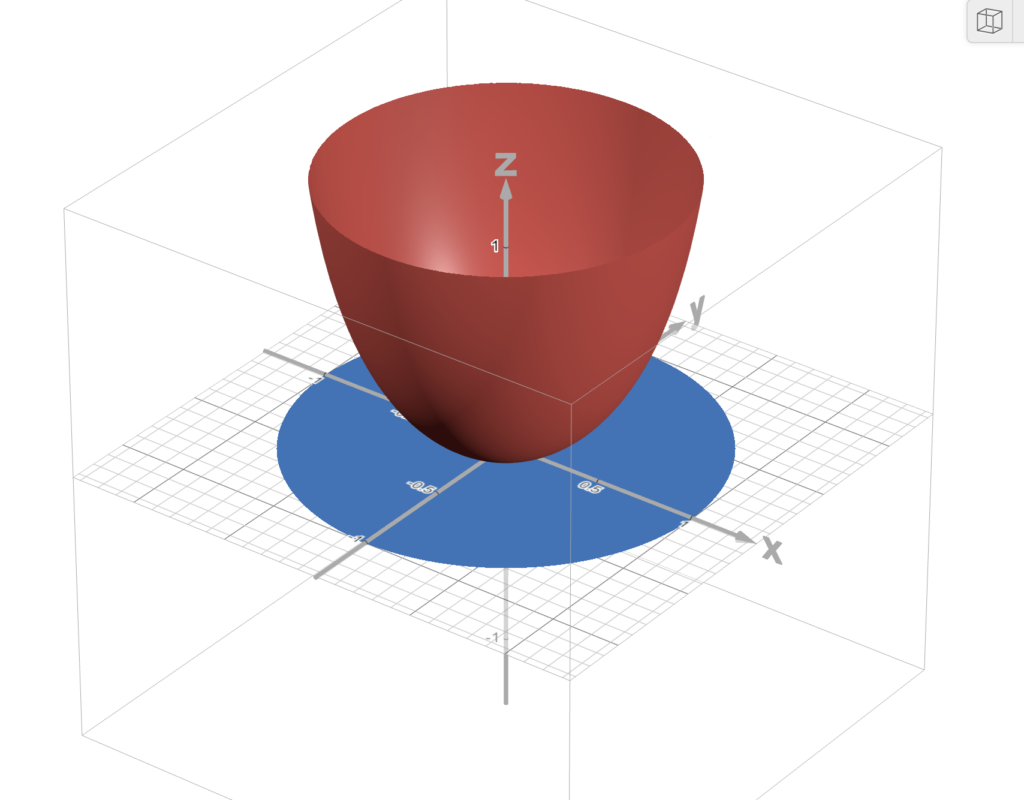
Here the red represents the integral and the blue represents the unit disk x^2 + y^2 < 1.
To put it concretely, we are asked to evaluate the function (red) at every point inside the unit disk (blue).
So we have to multiply each value by an infinitesimally small area , and add all of those contributions together.
Once we recognize that both the region and the integrand depend only on the distance from the origin, the natural next step is to replace Cartesian coordinates with polar coordinates.
Let’s do just that!
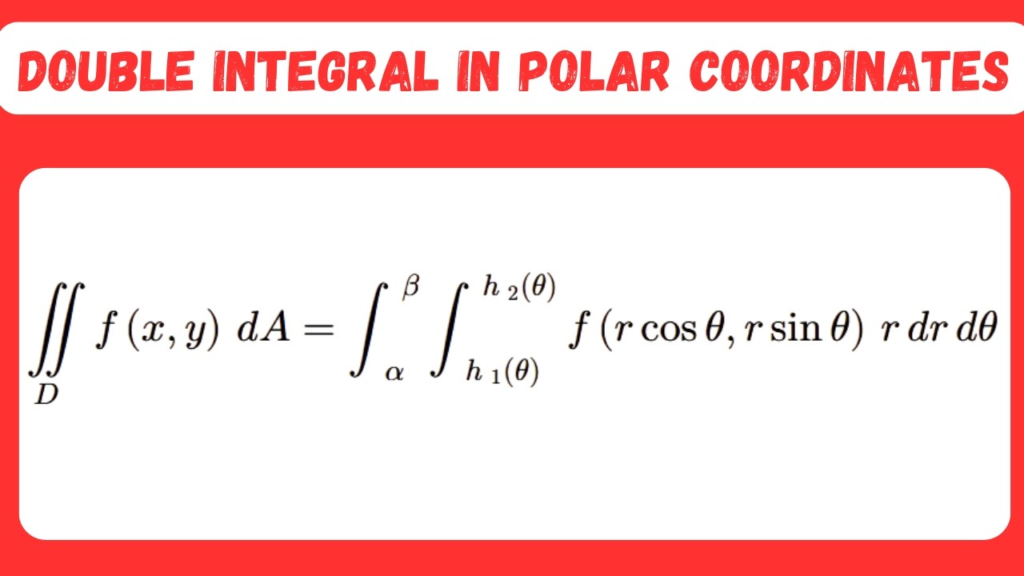
This is the theorem we are going to apply. We will convert our double integral from Cartesian coordinates into its polar form.
We do so thanks to the region D being the unit disk.

where 0 ≤ r ≤ 1, and 0 ≤ θ ≤ 2π.
This is where the magic begins. We will find what D is in terms of r and theta.
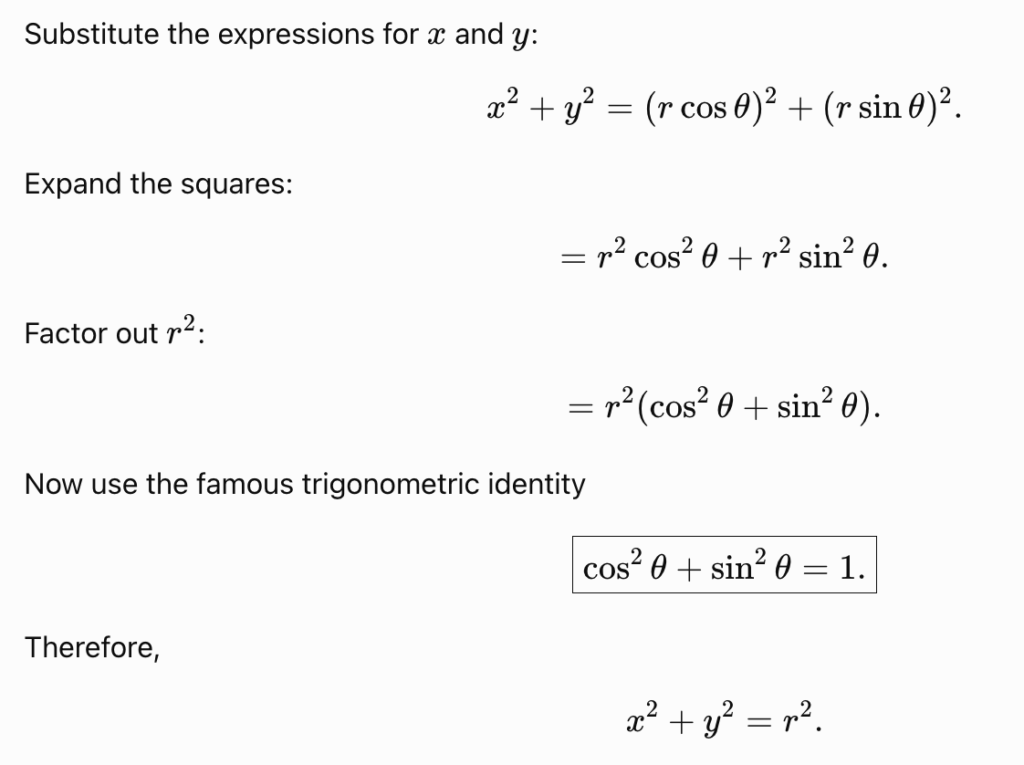
We also have
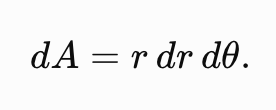
Thus the integral becomes

At this point, we can apply something called Fubini’s Theorem.
Oh actually, it should be a corollary resulting from it.

Basically if we ave a double integral where the limits are constant, then we can treat it as a product of two single integrals!
This applies to an N-dimensional integral so long as the constraints are satisfied.

Back to our double integral, here we turn it into a product of two single integrals.
The second integral is immediate.
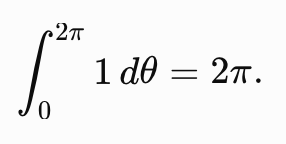
So what we really have to work with now is the following:
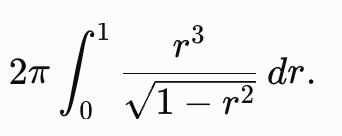
Look at how far we have come! From a double integral over a disk all the way to a single integral.
We now apply a clever u-substitution. Here the u is completely arbitrary, we can call it anything else really.
We let

Now since
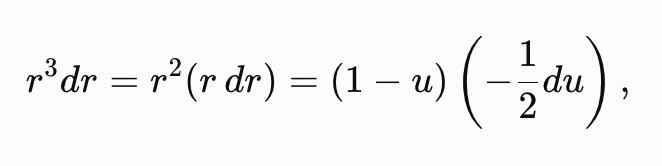
The rest is just plugging it in and standard operations.
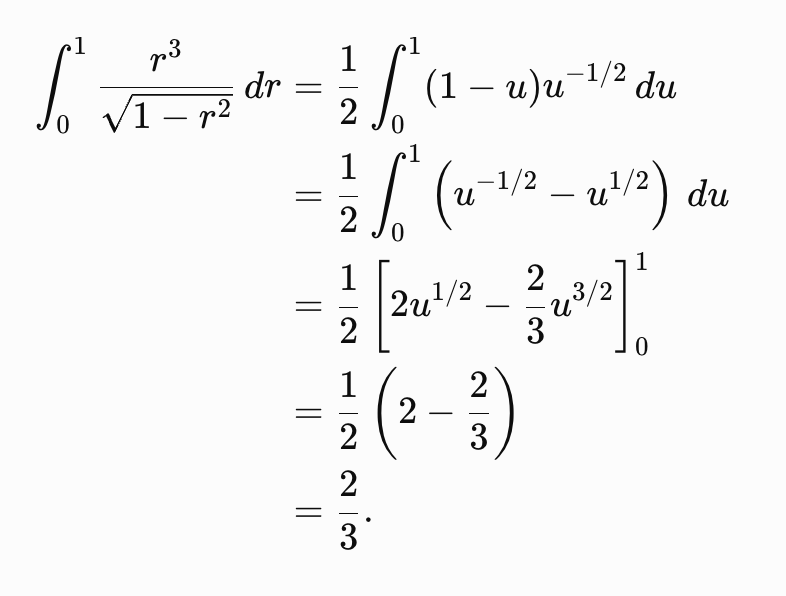
So multiplying the two integrals together, we get
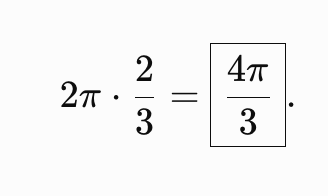
To conclude, the double integral is not merely an exercise in changing coordinates. It describes a circular world where every point carries a different weight. Near the centre, the contribution is small. Near the boundary, the density rises dramatically.
Hidden beneath the algebra is the geometry of a sphere, because the mysterious square root is the height of a hemisphere above the disk. The calculation is really a story about symmetry, geometry, and accumulation.
And that’s our answer. How amazing. Hey, don’t forget to clap👏 the article as a token of appreciation. Thank you 🦁