

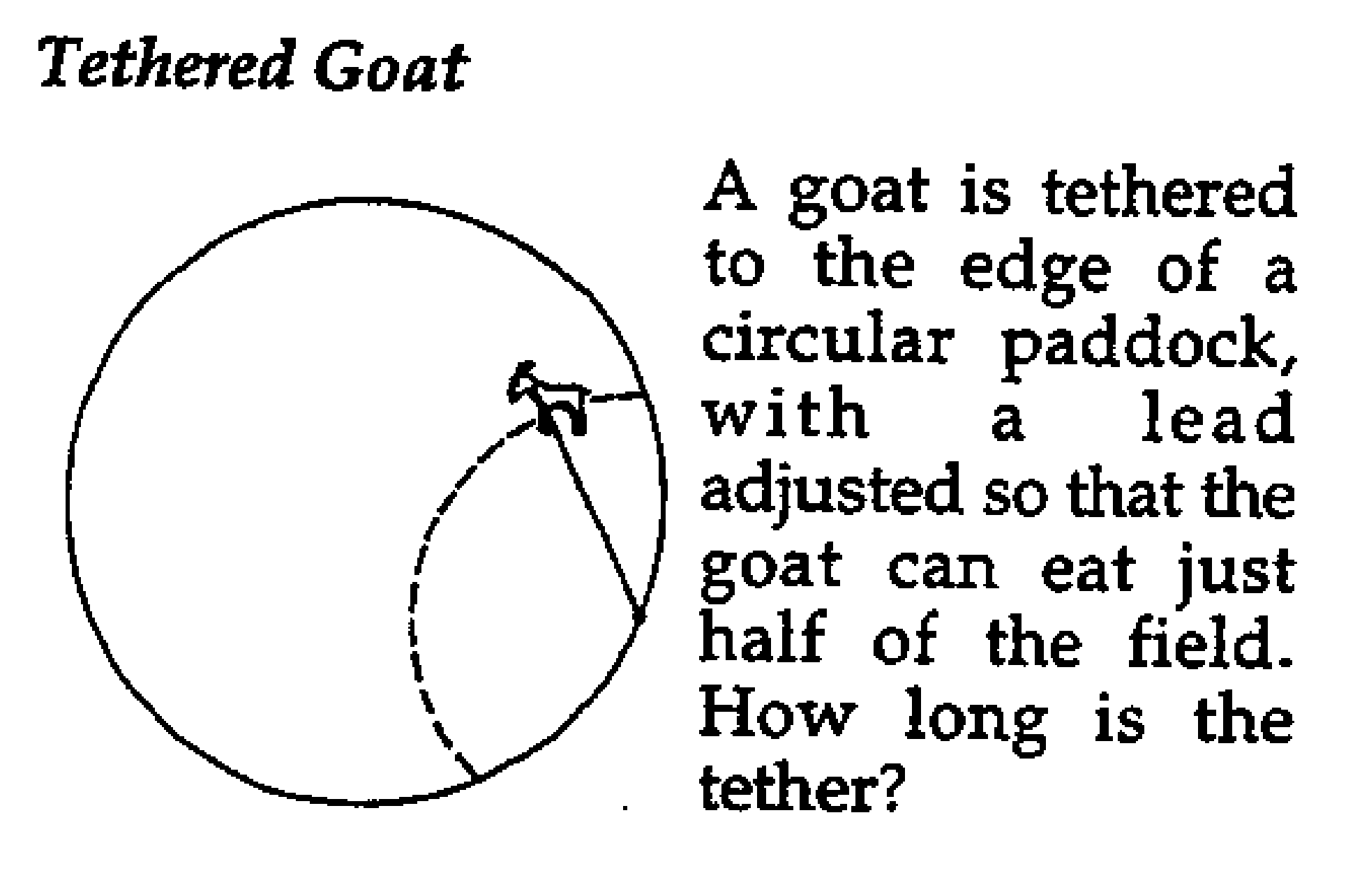
A goat is tethered to the edge of a circular paddock, with a lead adjusted so that the goat can eat just half of the field.
So can you tell us how long the tether must be?
Here’s a smoother paraphrased version that preserves the meaning while reading more naturally:
At first glance, it seems like nothing more than a high school geometry exercise. Yet this deceptively simple puzzle has fascinated mathematicians and puzzle enthusiasts for over 270 years. Although several variations have been solved, the original goat-and-rope problem has stubbornly resisted an exact solution, leaving only approximate answers.
Even after centuries of study, “nobody knows an exact answer to the basic original problem,” remarked Mark Meyerson. “The solution is only given approximately.”
That changed earlier this year when German mathematician Ingo Ullisch made a significant breakthrough, deriving what is believed to be the first exact solution. The catch is that the formula itself is far from elegant, taking a complicated form that is difficult to interpret.
“[This] is the first explicit expression that I’m aware of [for the length of the rope],” said Michael Harrison. “It certainly is an advance.”
Ullisch acknowledges that the result is unlikely to transform mathematics, since the problem exists largely in isolation rather than as part of a broader mathematical theory. Nevertheless, seemingly playful puzzles like this often inspire new ways of thinking, and the techniques developed to solve them can sometimes find unexpected applications elsewhere in mathematics.
Once again, this is a good moment to pause the article and give the problem a go yourself. When you’re ready, keep reading for the solution. And if you come up with your own approach, feel free to share it in the comments — I’d love to see how you tackled it.
Don’t forget to subscribe to our YouTube channel for more maths puzzles, it’s my goal to reach 100k subscribers someday.
Solution
Here’s a calculus-based approach. But hey you are free to solve it however you want!
Let’s consider the following diagram.
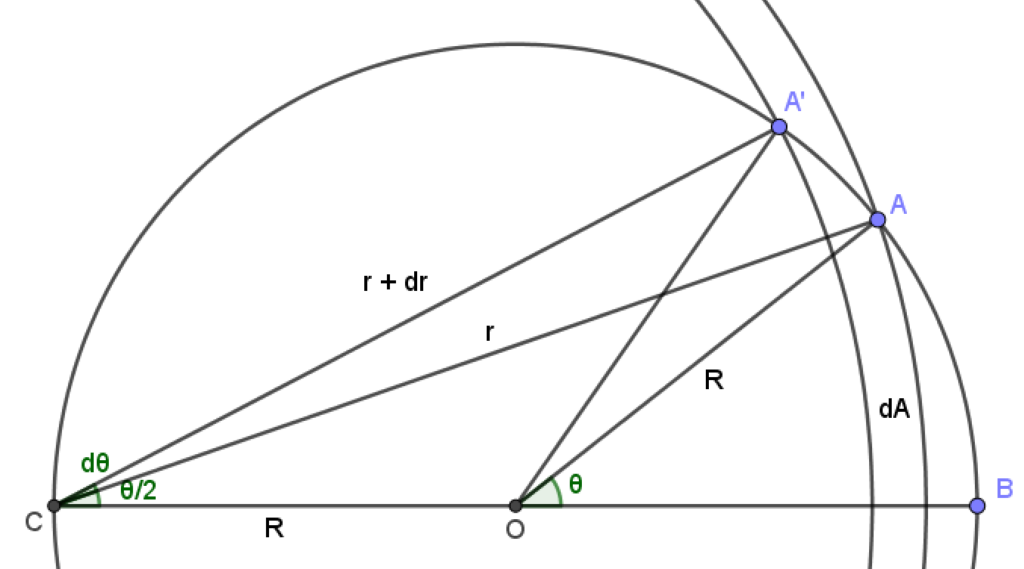
The circular field is centered at O. The goat is tethered at C and the tether has length r. Let B be the point diametrically opposed to C and let A be the farthest point along the perimeter that the goat can reach. Let θ be the angle BOA, as shown. If r changes a little bit, by some amount dr, then θ will change by some amount dθ. Likewise, the fraction of the total area reachable by the goat will change by dA. Let’s calculate how these quantities are related.
First, note that dA is simply the area between the two circular arcs centered at C and passing through A and A’, respectively. We must also divide by the total area of the field in order to get a ratio. As dr → 0, we have:
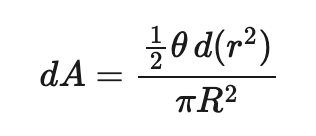
Our next task is to find out how dθ is related to d(r^2). Look at the triangle OAC.
By the law of cosines, we have

We will then differentiate this with respect to θ
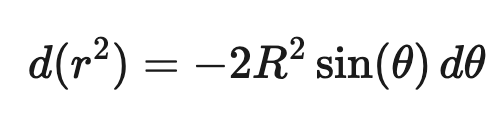
Substituting back into our expression for dA, we obtain
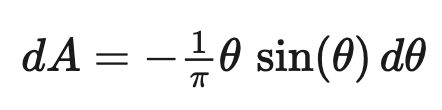
Let’s do some integration. Note that A = 1 when θ = 0. Therefore, we have:
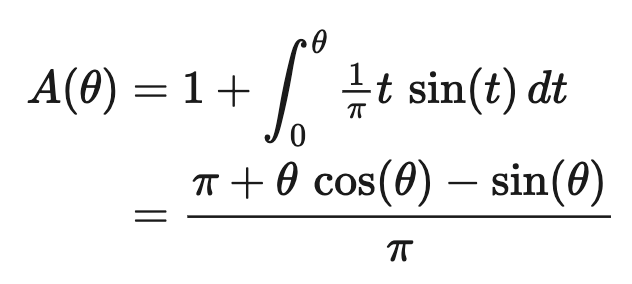
This tells us the ratio of areas as a function of θ. If we want this as a function of r instead, we can use the law of cosines again to eliminate θ and write A as a function of r. This yields:

Here the substitution ρ = r/R is made.
And if we plot this quantity as a function of ρ, we get
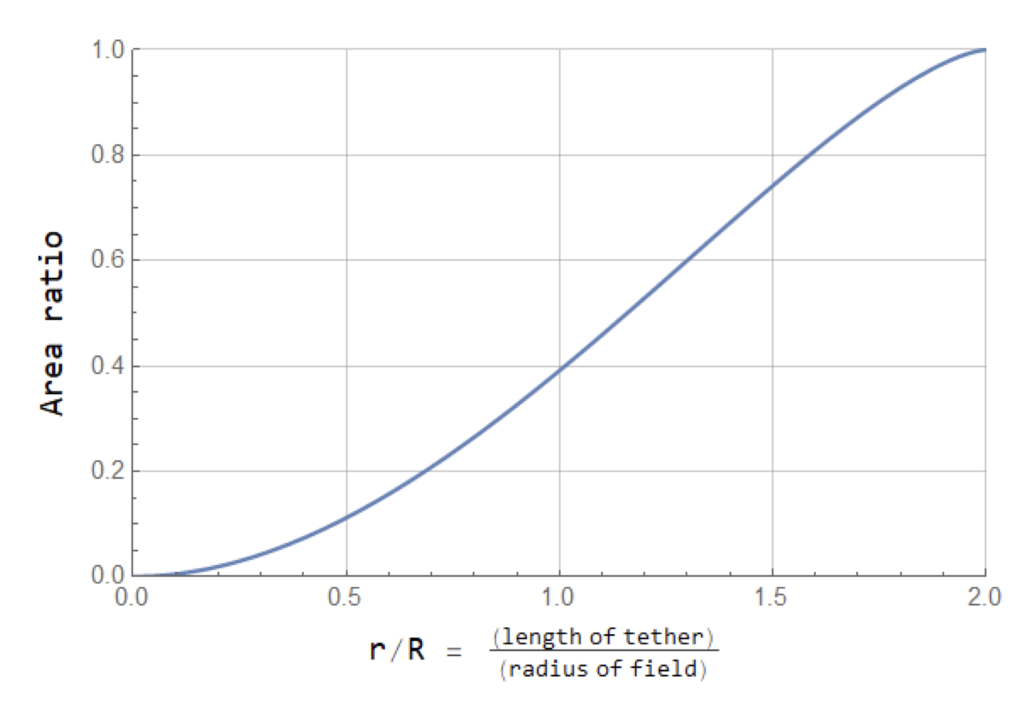
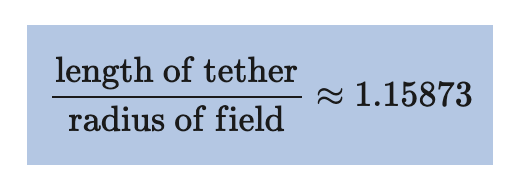
As we might expect, when r = 0, A = 0. And the area ratio grows monotonically with r until we reach r = 2R, at which point the goat can reach the farthest point (which is point B) and therefore can reach the entire field. There is no closed-form expression for the exact tether length that leads to a particular area ratio, since that would require solving the above A(ρ) for ρ. However, we can easily solve the equation numerically. Doing so, we obtain:
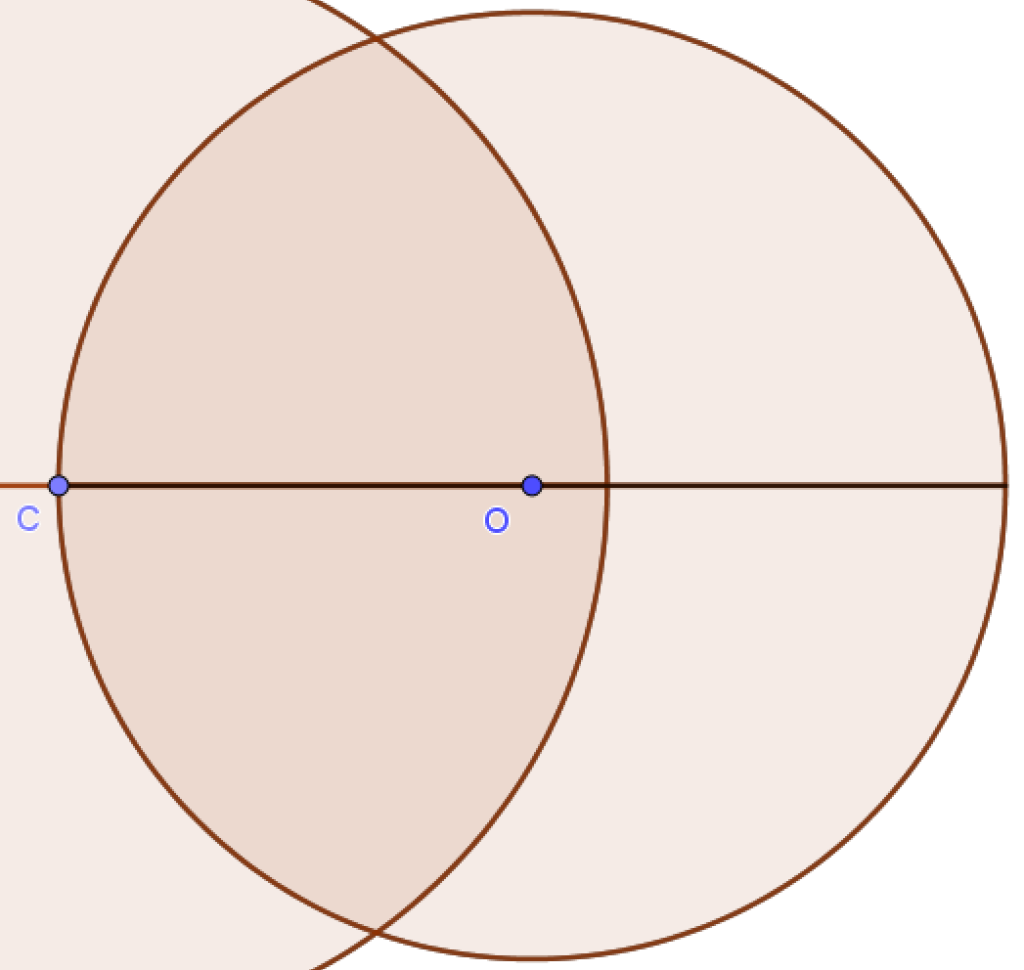
Finally, here is a diagram of what the field and tether look like when the area ratio is exactly 1/2.
Some Trivia
The first problem of this type was published in the 1748 issue of the London-based periodical The Ladies Diary: Or, The Woman’s Almanack — a publication that promised to present “new improvements in arts and sciences, and many diverting particulars.”
The original scenario involves “a horse tied to feed in a Gentlemen’s Park.” In this case, the horse is tied to the outside of a circular fence. If the length of the rope is the same as the circumference of the fence, what is the maximum area upon which the horse can feed? This version was subsequently classified as an “exterior problem,” since it concerned grazing outside, rather than inside, the circle.

An answer appeared in the Diary’s 1749 edition. It was furnished by “Mr. Heath,” who relied upon “Trial and a Table of Logarithms,” among other resources, to reach his conclusion.
Heath’s answer — 76,257.86 square yards for a 160-yard rope — was an approximation rather than an exact solution. To illustrate the difference, consider the equation x2 − 2 = 0. One could derive an approximate numerical answer, x = 1.4142, but that’s not as accurate or satisfying as the exact solution, x = √2.
The problem reemerged in 1894 in the first issue of the American Mathematical Monthly, recast as the initial grazer-in-a-fence problem (this time without any reference to farm animals). This type is classified as an interior problem and tends to be more challenging than its exterior counterpart, Ullisch explained. In the exterior problem, you start with the radius of the circle and length of the rope and compute the area. You can solve it through integration.
“Reversing this procedure — starting with a given area and asking which inputs result in this area — is much more involved,” Ullisch said.
In the decades that followed, the Monthly published variations on the interior problem, which mainly involved horses (and in at least one case a mule) rather than goats, with fences that were circular, square and elliptical in shape. But in the 1960s, for mysterious reasons, goats started displacing horses in the grazing-problem literature — this despite the fact that goats, according to the mathematician Marshall Fraser, may be “too independent to submit to tethering.”
And that’s our answer. How amazing. Hey, don’t forget to clap👏 the article as a token of appreciation. Thank you 🦁