
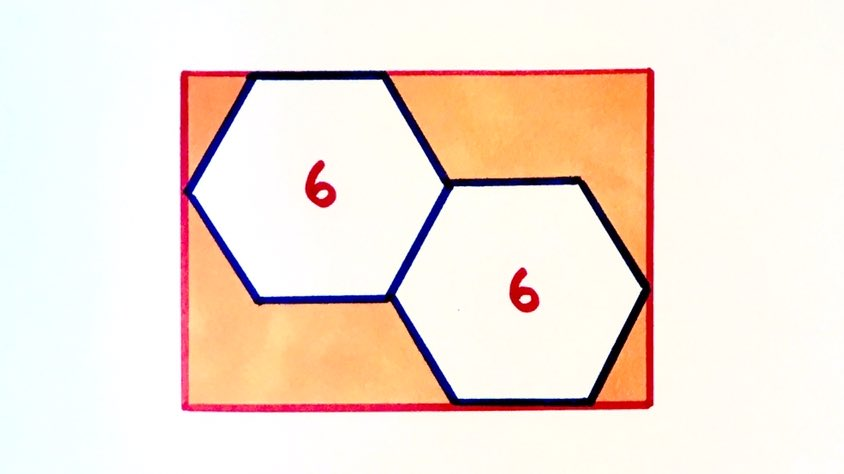
This is another geometry puzzle by Catriona Agg on X.
Both the regular hexagons have area 6. What’s the total shaded area?
Once again, this is a good moment to pause the article and give the problem a go yourself. When you’re ready, keep reading for the solution. And if you come up with your own approach, feel free to share it in the comments — I’d love to see how you tackled it.
Don’t forget to subscribe to our YouTube channel for more maths puzzles, it’s my goal to reach 100k subscribers someday.
Multiple Solutions
Instead of providing my solution, I thought it would be a good idea to look at a number of approaches by other people.
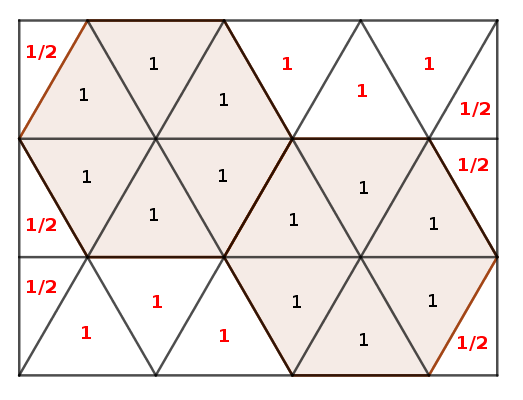
Nèstor posed the above solution. Here he dissected the whole diagram into a number of equilateral triangles with area 1, and a few more triangles with area 1/2.
We know that a regular hexagon is composed of 6 equilateral triangles. In our case, each has area 1 because the hexagons have area 6.
It’s also easy to see that the smaller triangles have area 1/2 because they share the same height as the equilateral triangles and half their base.
So the maths checks out!
Now if we add up all the areas outside the hexagons, we find that the shaded region is 9.
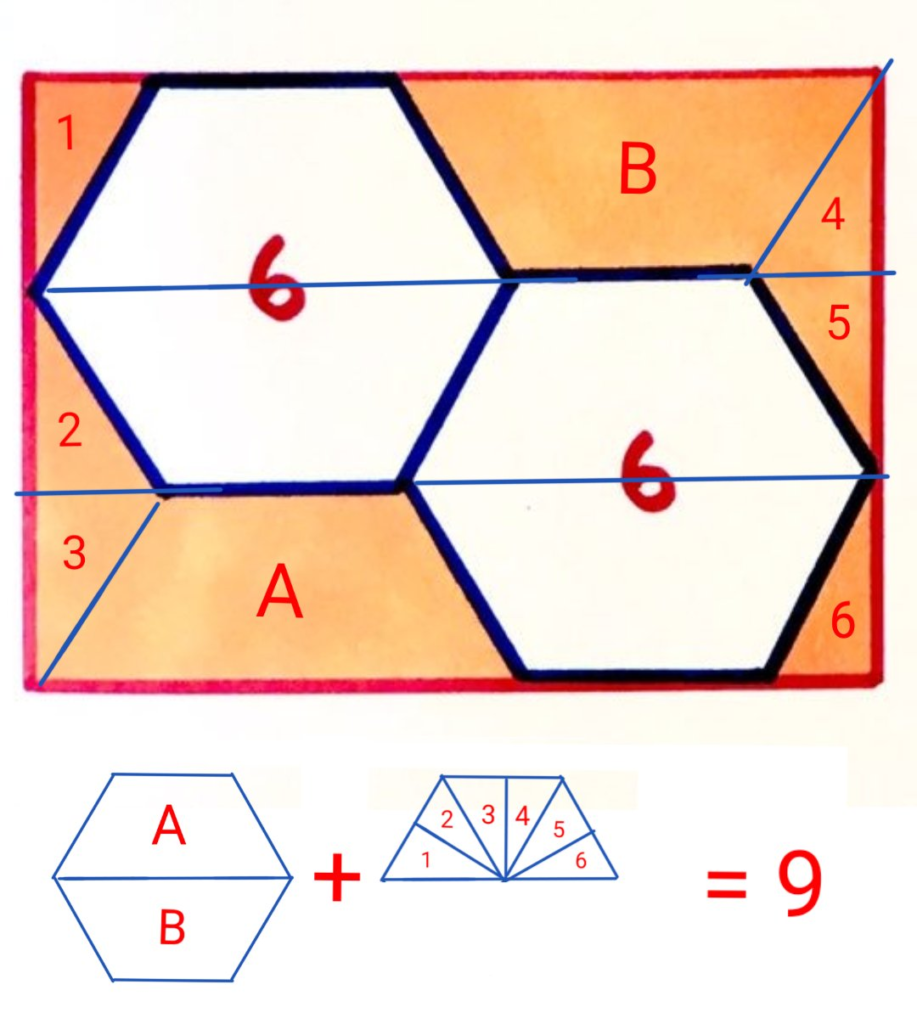
This is a similar yet slightly different approach by Amit.
Here he adds a few lines to the diagram. Specifically, he shows that the shaded region is equivalent to one hexagon and half a hexagon, which works out to have area 6 + 6/2 = 9.
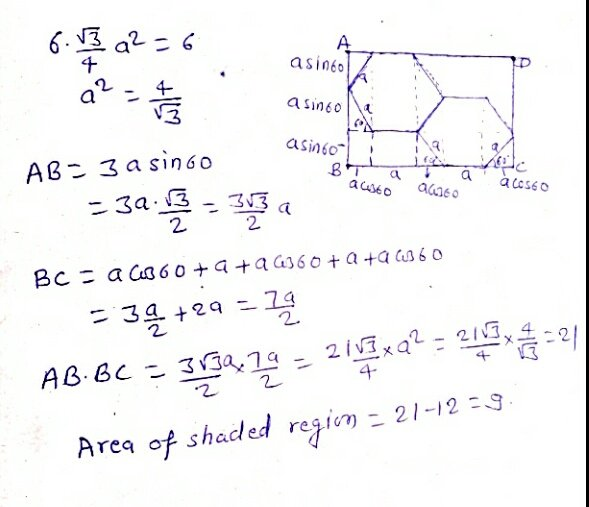
Here’s a more computational approach by Vivekanand.
It’s not as elegant because we need trigonometry and it probably takes a longer time to get to the answer.
He first finds the area of the overall rectangle and then subtract the area of the hexagons for that, resulting in 9 as the shaded area.
And that’s our answer. How amazing. Hey, don’t forget to clap👏 the article as a token of appreciation. Thank you 🦁