
Here’s a fun teaser for you.
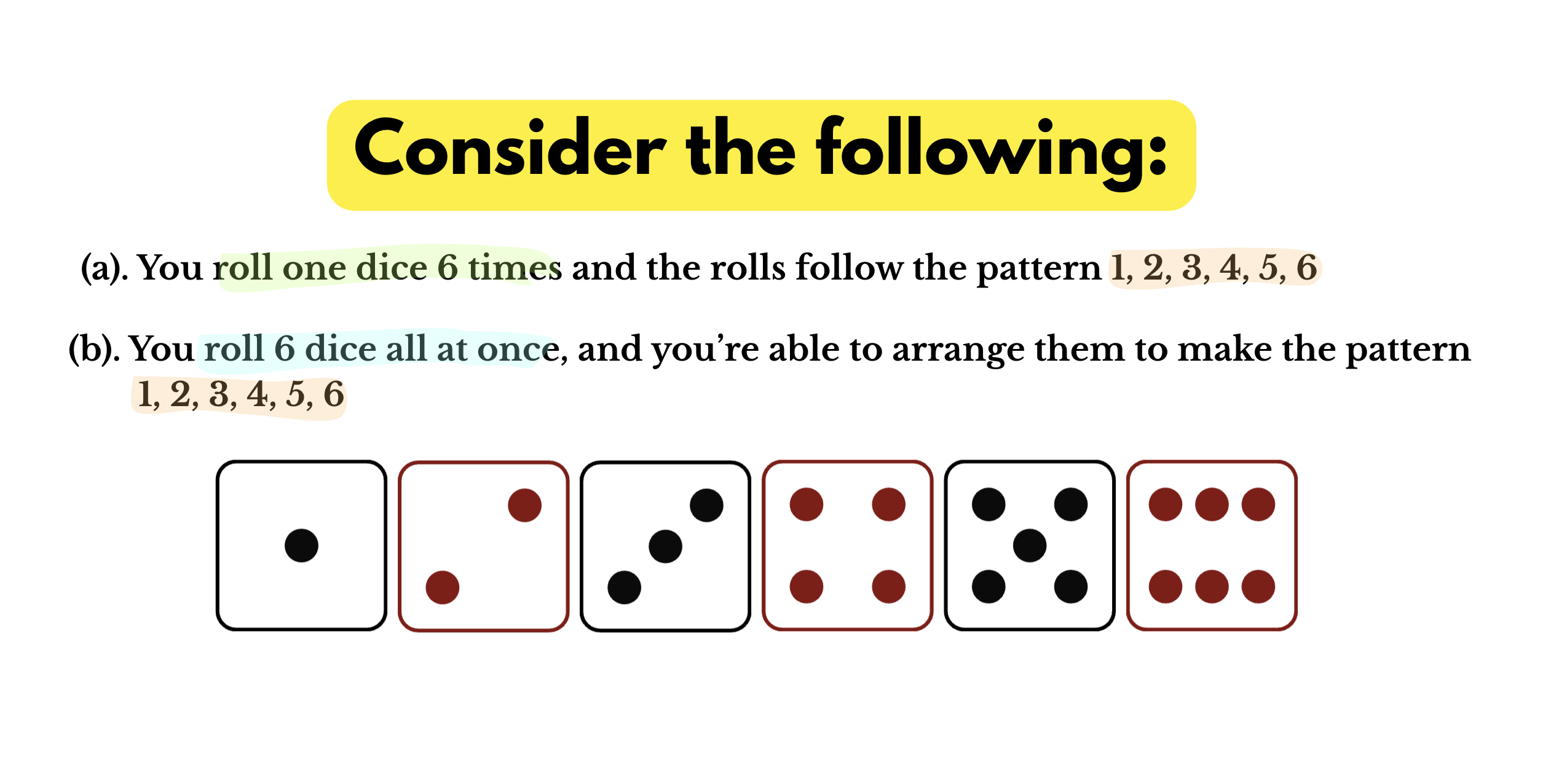
Consider the following scenarios:
- (a), You roll one dice 6 times and the rolls follow the pattern 1, 2, 3, 4, 5, 6
- (b). You roll 6 dice all at once, and you’re able to arrange them to make the pattern
So can you tell me which outcome is more likely? Or are they of equal odds?
Once again, this is a good moment to pause the article and give the problem a go yourself. When you’re ready, keep reading for the solution. And if you come up with your own approach, feel free to share it in the comments — I’d love to see how you tackled it.
Don’t forget to subscribe to our YouTube channel for more maths puzzles, it’s my goal to reach 100k subscribers someday.
Solution
We can get to the answer quickly without going through the maths.
In scenario (a), we want the first roll to be 1, the second roll to be 2, so on and so forth. There’s only one way this can be achieved.
In scenario (b), all we want is the same 6 numbers from {1, 2, 3, 4, 5, 6}. But because the numbers can be rolled in any order, this situation is more likely. For example, rolling a 234515 is just as valid as 643521.
One way to visualise this is that although the 6 dice are rolled at once, we can still see it as each die being rolled one after another. Clearly scenario (b) is more likely to happen.
Now let’s see if the maths checks out.
Scenario (A)
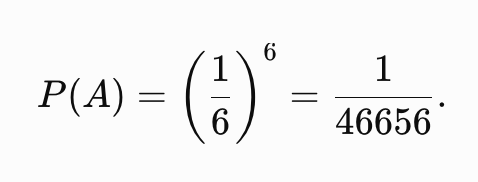
Each roll has a probability 1/6 of getting the right number.
Scenario (B)
You roll 6 dice simultaneously, and you’re allowed to rearrange them.
The only thing that matters is that you obtain one of each face.
There are
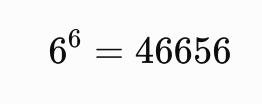
possible outcomes.
How many are favourable?
If the six dice show exactly one 1, one 2, …, one 6, those numbers can appear on the six dice in
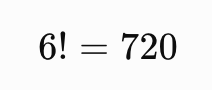
different arrangements.
So
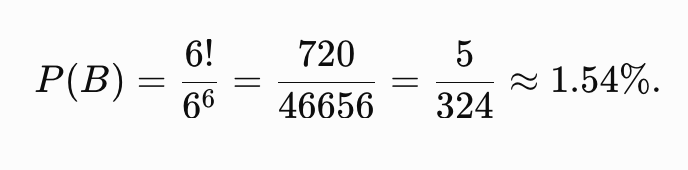
Indeed the maths checks out!
And that’s our answer. How amazing. Hey, don’t forget to clap👏 the article as a token of appreciation. Thank you 🦁