

To understand the universe, scientists often seek the strange wanderers at its edges. “You always want to know about the extreme cases — the special cases that lie at the edge,” said Carsten Gundlach, a mathematical physicist at the University of Southampton.
Among the universe’s oldest legends made real are black holes—mysterious realms where matter is gathered so tightly that, according to Einstein’s general theory of relativity, not even light can find its way home. For generations, physicists and mathematicians have treated them like ancient riddles, testing the limits of what they know about gravity, space, and time.
Yet even these cosmic titans have their rarest kindred. Black holes spin through the heavens, whirling ever faster as they feast on falling matter. Should that matter carry electric charge, the black hole inherits it as well. In theory, there comes a fabled threshold where a black hole bears all the spin or charge its mass can endure. Such a one is called extremal—the most extraordinary among the universe’s extraordinary beings.
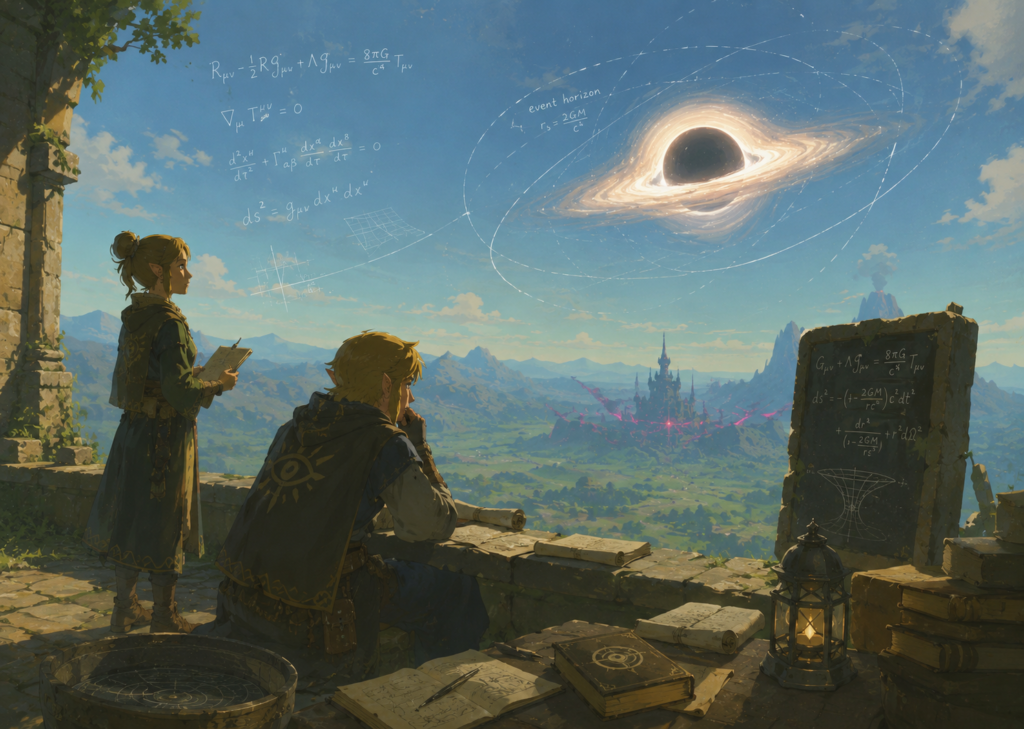
These rare black holes possess qualities that seem almost enchanted. At the edge of an extremal black hole—the event horizon where all paths inward begin—the so-called surface gravity falls silent. “It is a black hole whose surface doesn’t attract things anymore,” Gundlach said. Yet this calm is deceptive. A particle nudged ever so slightly toward its heart would still find no road back, as though crossing an unseen threshold from which no traveler returns.
In 1973, the renowned physicists Stephen Hawking, James Bardeen, and Brandon Carter proposed that such perfect black holes could never truly be born. Nature, they argued, offers no believable path to create them. Even so, for more than half a century, extremal black holes have endured as the theorist’s favorite thought-spirits. Their hidden symmetries make the mathematics unusually graceful. “They have nice symmetries that make it easier to calculate things,” said Gaurav Khanna of the University of Rhode Island. Those symmetries have turned these seemingly impossible objects into trusted guides for exploring one of physics’ oldest mysteries: how the strange laws of quantum mechanics might one day be woven together with gravity.

Now, two mathematicians have rewritten what many believed was settled lore. In a pair of recent papers, Christoph Kehle of the Massachusetts Institute of Technology and Ryan Unger of Stanford University and the University of California, Berkeley showed that nothing in the known laws of physics forbids an extremal black hole from coming into being.
Their proof has been hailed as both elegant and unexpected. Mihalis Dafermos, a mathematician at Princeton University and doctoral adviser to Kehle and Unger, called it “beautiful, technically innovative and physically surprising.” More intriguingly, it suggests that the universe’s hidden bestiary may be richer than once imagined—that these legendary black holes need not remain creatures of mathematics alone, but could wander the cosmos in reality.
Yet the tale remains unfinished. A possibility on paper is not a promise from nature. “Just because a mathematical solution exists that has nice properties doesn’t necessarily mean that nature will make use of it,” said Gaurav Khanna. Still, should astronomers ever uncover one of these elusive cosmic phantoms, it would reveal that something fundamental has escaped our understanding. Such a discovery, he suggested, would not merely answer old questions—it would summon entirely new ones, forcing us to rethink the stories we tell about the universe itself.
The Law of the Unreachable
Before Kehle and Unger’s work, there seemed every reason to believe that extremal black holes belonged to the realm of impossible things.
In 1973, James Bardeen, Brandon Carter, and Stephen Hawking laid down four laws to govern black holes—principles that echoed the ancient laws of thermodynamics, those steadfast rules declaring that energy cannot simply appear or vanish, and that the universe drifts ever toward greater disorder.
They succeeded in proving the first three laws: the zeroth, the first, and the second. The fourth, however, remained beyond their reach. Even so, they believed it must hold, much as the oldest storytellers trust that an unfinished tale still follows its destined path.
This third law proclaimed that a black hole’s surface gravity could never fall to zero within any finite span of time. In other words, the perfect extremal black hole would forever remain beyond nature’s grasp. Their reasoning was compelling: any process capable of pushing a black hole to its ultimate limit of spin or electric charge might also erase the very boundary that makes it a black hole—the event horizon. Beyond that vanished veil would lie a naked singularity, a forbidden thing that many physicists believe the universe carefully hides from view.
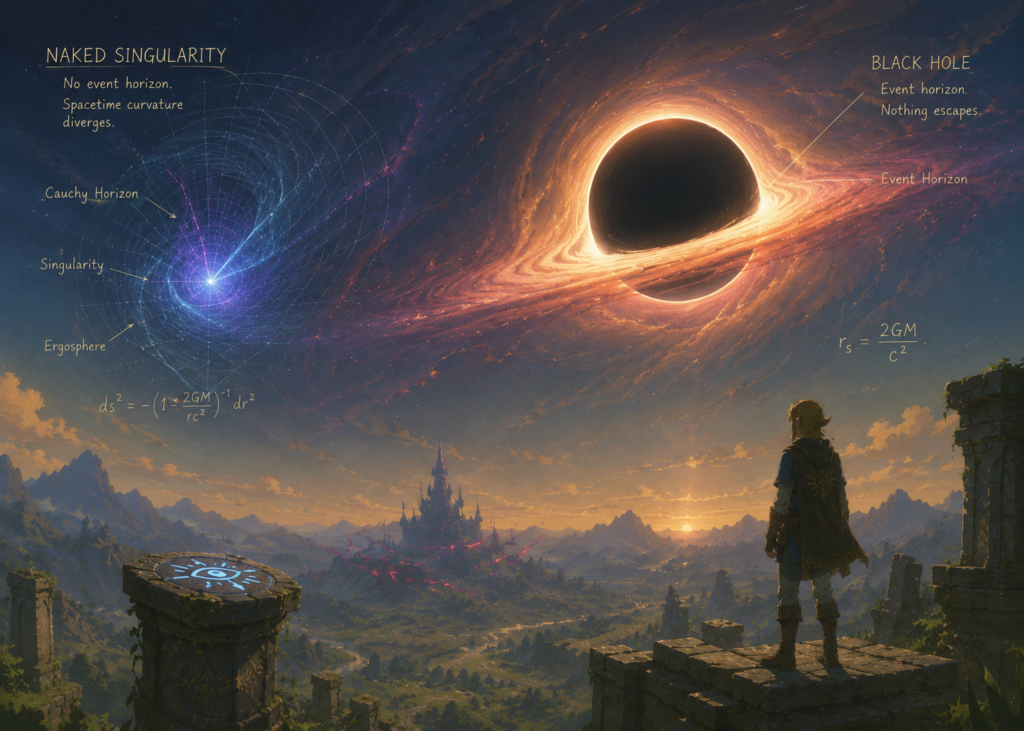
There was another mystery woven into the argument. A black hole’s temperature is tied directly to its surface gravity. If the surface gravity vanished, so too would its warmth. Such a black hole would become perfectly cold, emitting none of the faint thermal glow that Hawking would later argue every black hole must eventually release.
More than a decade later, in 1986, the physicist Werner Israel appeared to seal the matter. His proof seemed to show that no matter how one tried to feed a black hole charged particles or whip it into ever-faster rotation, its surface gravity could never be driven all the way to zero within finite time. The gate to the extremal realm seemed firmly barred.
But legends often hide a forgotten crack in the wall. Decades later, Kehle and Unger uncovered one concealed within Israel’s elegant argument—a subtle flaw that had lain unnoticed for nearly forty years, waiting for someone patient enough to find it.
The Fall of the Third Law
Kehle and Unger were not hunting for extremal black holes. Like travelers who set out in search of one path only to discover another, they found them by chance.
Their work began with an ordinary question: how electrically charged black holes come into being. “We realized that we could do it,” Kehle said—to form a black hole “for all charge-to-mass ratios.” Hidden among those possibilities was the rarest case of all: a black hole carrying the greatest charge its mass could bear, the unmistakable mark of an extremal black hole.
When Mihalis Dafermos saw what his former students had uncovered, he recognized the significance at once. They had found a counterexample to the third law of black hole thermodynamics. Against decades of expectation, they had shown that an ordinary black hole could indeed be guided to the extremal state within a finite span of time.
Their thought experiment began with the simplest of black holes—one that neither spun nor carried electric charge. They placed it within an idealized sea known as a scalar field, imagining it immersed in a uniform mist of charged particles. Then, like careful smiths tempering a blade, they struck it with gentle pulses from the field, each one adding a measure of electric charge.

Those pulses also carried energy, increasing the black hole’s mass. But Kehle and Unger discovered a subtle trick. By sending broad, low-frequency waves instead of sharper bursts, they could let the charge accumulate more quickly than the mass. Little by little, the black hole approached the fabled extremal threshold.
After sharing their discovery with Dafermos, they turned back to Werner Israel’s celebrated proof from 1986. There, hidden beneath decades of acceptance, they uncovered a flaw. They went further still, devising two additional solutions to Einstein’s equations that reached the same destination by different paths. Three independent routes all led to the same conclusion. For Unger, the verdict was unmistakable: “The third law is dead.”
Yet another old fear also faded. Physicists had long worried that creating an extremal black hole might tear away the event horizon altogether, exposing the forbidden naked singularity beneath. Instead, Kehle and Unger found something more delicate. The extremal black hole stands upon a razor’s edge. Give a dense cloud of charged matter exactly the right measure of charge, and it collapses into an extremal black hole. Give it even more, and the cloud refuses to collapse at all, scattering back into the void instead of revealing the forbidden heart of spacetime.
In that sense, the universe behaves less like a reckless conjurer than a careful keeper of its oldest secrets. Extremal black holes appear not as gateways to forbidden realms, but as guardians standing at the very boundary between what may form and what must remain forever unrealized.
“This is a beautiful example of math giving back to physics,” said Elena Giorgi, a mathematician at Columbia University.
When the Impossible Steps Into the Light
Kehle and Unger’s work does not prove that extremal black holes roam the cosmos. It shows only that the old prohibition was never written into the laws of nature. The gate, once thought forever sealed, is in fact unlocked.
Even so, the path remains uncertain. The black holes in their proof possess the greatest electric charge their mass can sustain, yet no astronomer has ever found convincing evidence of a highly charged black hole. If nature favors the extremal kind, it is more likely to reveal them through furious rotation than through electric charge.
That is the next trail Kehle and Unger hope to follow. They aim to show that a spinning black hole can also reach the extremal threshold. But that journey leads into far rougher mathematical country. “You need a lot of new math, and new ideas, to do that,” Unger said. Their exploration has only just begun.
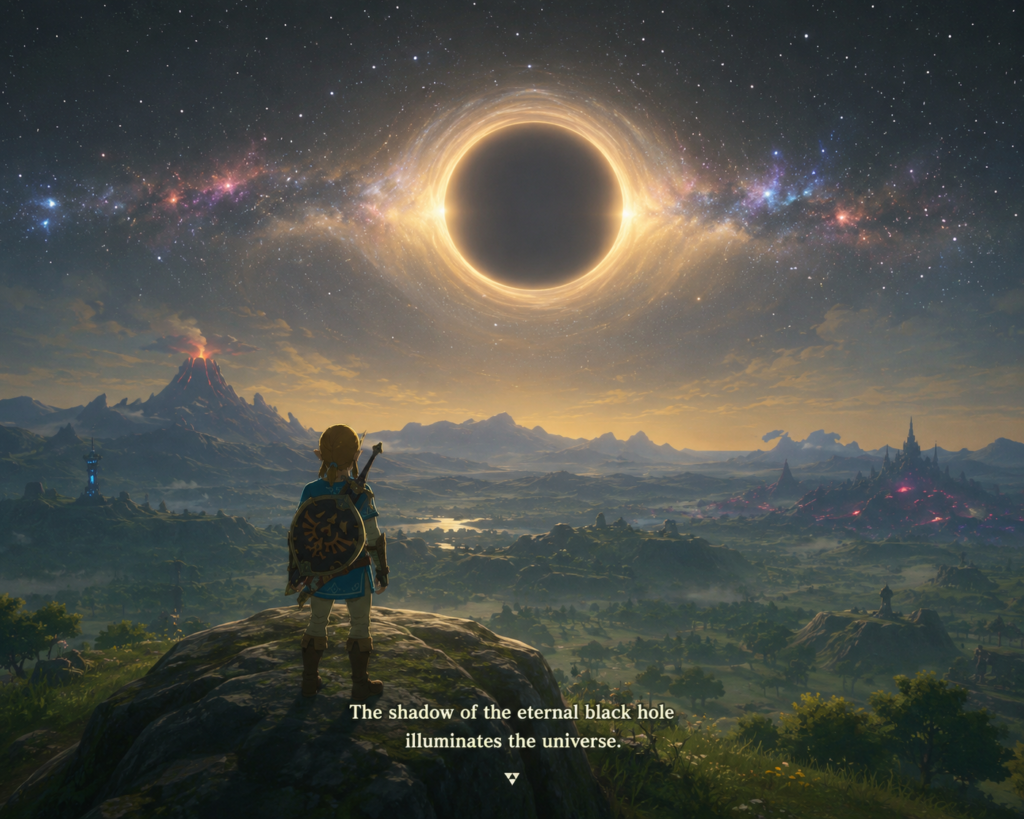
Yet even if the perfect extremal black hole remains hidden, its shadow may still illuminate the universe. Objects that come close to the extremal limit—near-extremal black holes—are believed to be common among the countless black holes scattered across the cosmos. Understanding the legendary ideal may therefore help explain the more ordinary wonders that astronomers actually observe.
History offers a quiet reminder of how often nature outgrows imagination. Einstein himself doubted that black holes could truly exist, finding them too strange to belong to the real universe. Yet today we know the heavens are filled with them. As Gaurav Khanna put it, “Einstein didn’t think that black holes could be real [because] they’re just too weird. But now we know the universe is teeming with black holes.”
Perhaps extremal black holes deserve the same patience. They may remain hidden beyond our current sight, or they may one day emerge from the darkness, reminding us once again that the universe is rarely constrained by what we believe to be possible. “We shouldn’t give up on extremal black holes,” Khanna said. “I just don’t want to put limits on nature’s creativity.”