

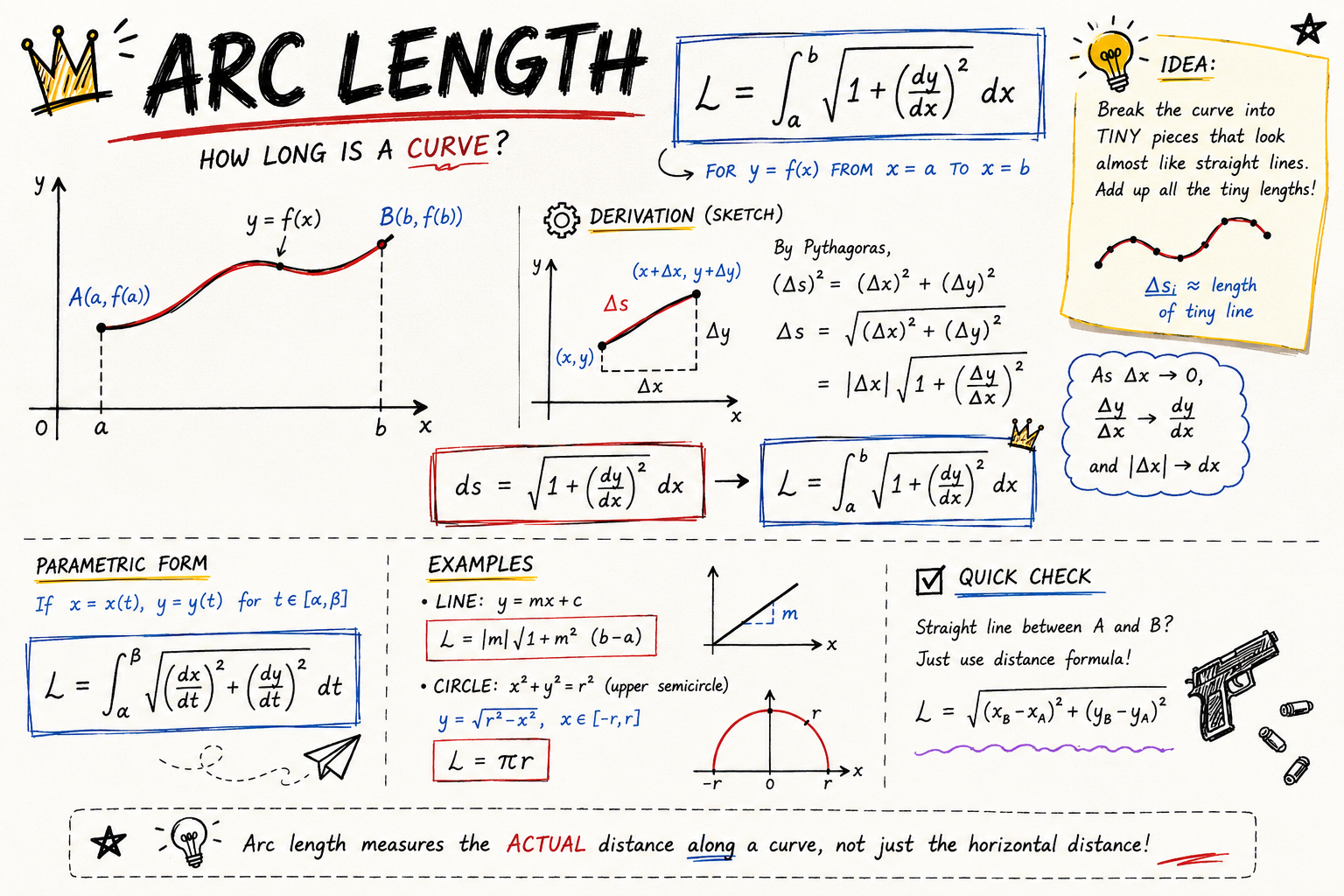
In this article, we will take a deep dive into the derivations of the arc length of a curve and the surface area of the revolution of a curve.
Without further ado, let’s dive in!
If you have been enjoying the content on our blog, consider checking out our website here. I have made some changes to it recently. Thank you.
Finding The Arc Length
Suppose that P(x, y) is any point on the curve C, whose equation is y = f(x), and that the length of the arc from a fixed point on C to P is denoted by s.
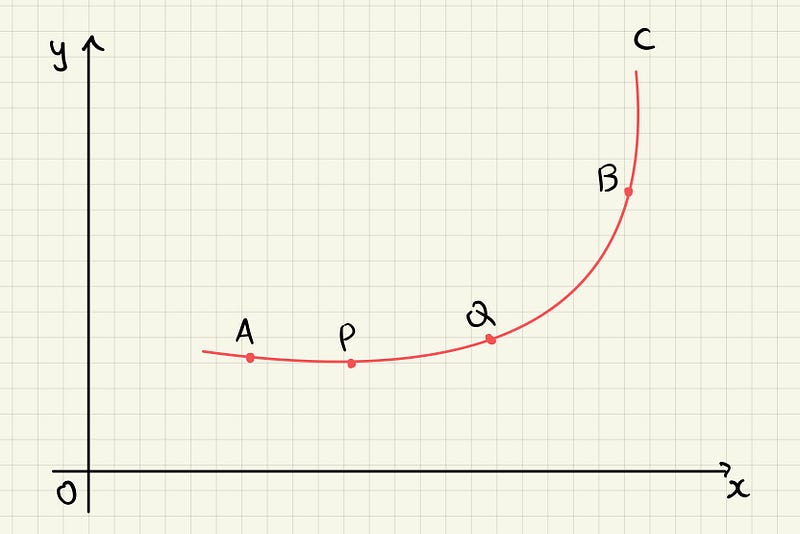
Let Q(x + 𝛿x, y + 𝛿y) be a neighbouring point on C, and the length of the arc PQ be 𝛿s.
As P and Q are close together, 𝛿s ≈ the length of the chord PQ.
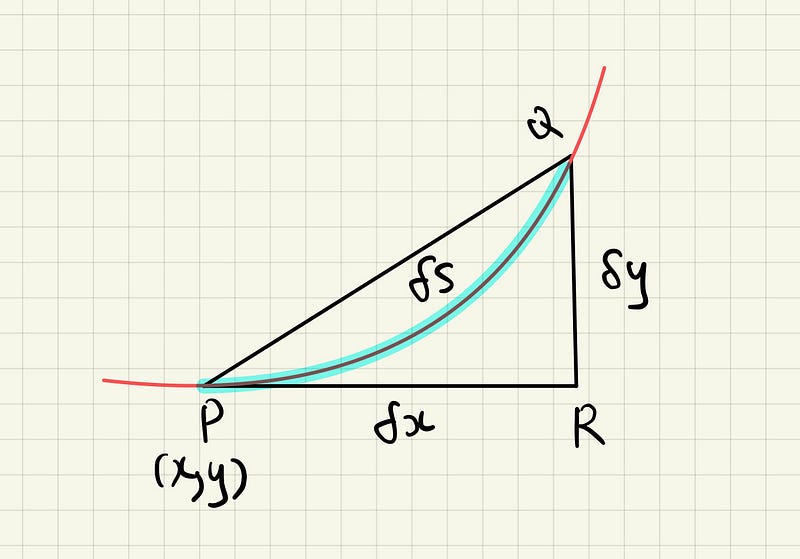
Therefore, using Pythagoras’ Theorem
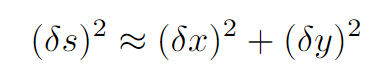
Diving by 𝛿x² gives us
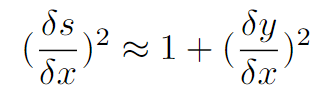
As 𝛿s approaches 0 (Q approaches P), we have
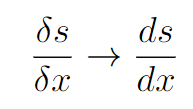
and
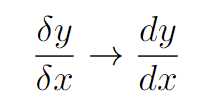
Taking the square root gives us
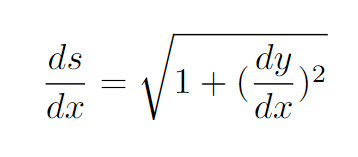
Notice that the positive square root is taken so that s increases as x increases.
Integrating this with respect to x gives an expression for s, the arc length.
If s is the length of arc joining A(xA, yA) and B(xB, yB),
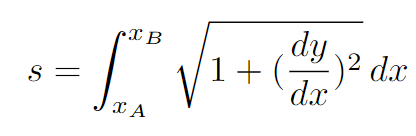
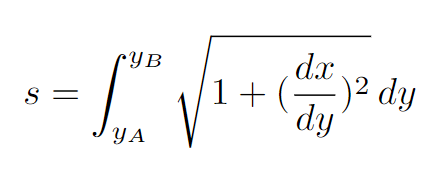
Alternatively, we can divide throughout by (𝛿y)² and proceed to the limit and integrate with respect to y
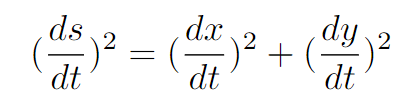
If the equation is given parametrically, dividing by (𝛿t)² and proceeding to the limit
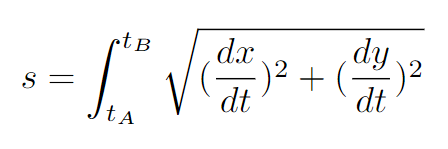
Given that the parameters at A and B are tA and tB respectively, integrating with respect to t gives us
Finding The Surface Area
Consider the curve C being rotated completely about the x-axis, and let the surface area generated by an arc between a fixed point on the curve and the point P(x, y) be S.
If Q(x + 𝛿x, y + 𝛿y) is a neighbouring point on C, then the arc PQ generates a surface of area 𝛿S, which is approximately equal to that of a frustum of a cone.
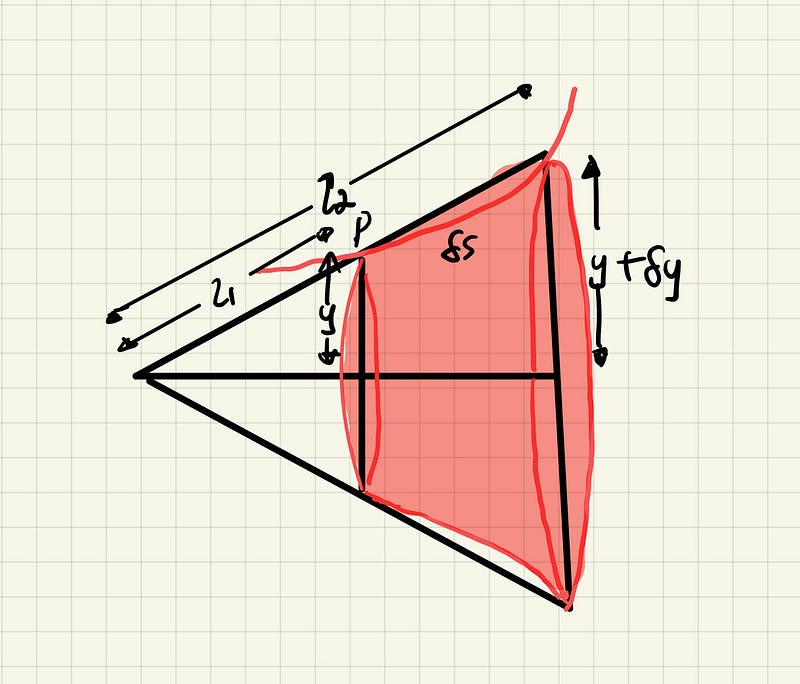
The surface area of a cone is πrl, where r is the radius and l the slant height.
The area of the frustum

As P and Q are close together, 𝛿S ≈ chord PQ = l2 -l1
so
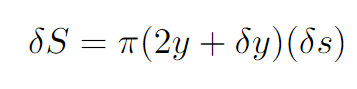
and dividing by 𝛿x gives us
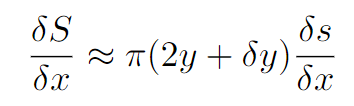
As Q approaches P,
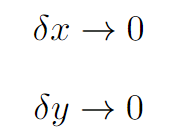
and
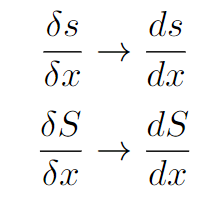
Therefore
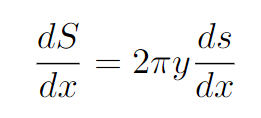
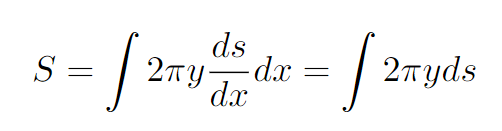
S can be found by integrating with respect to x.
The surface area is therefore
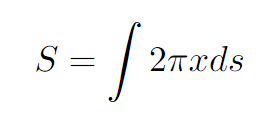
Similarly, if the curve is rotated about the y-axis, then
A Challenge Question
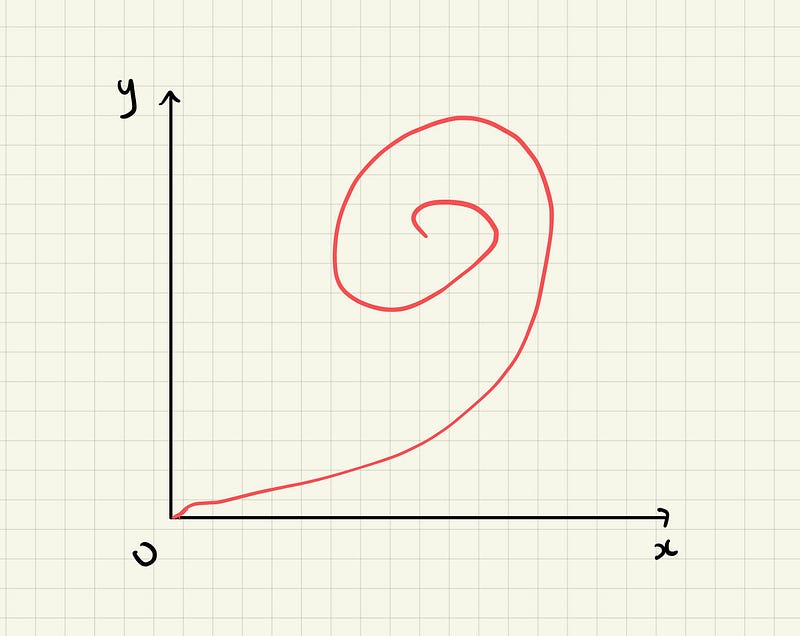
The diagram shows a Cornu spiral which has parametric equations
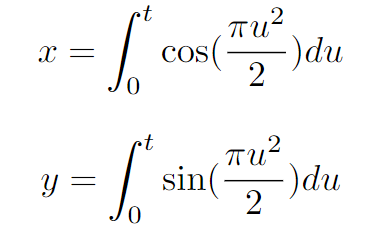
Find the length of the Cornu spiral!