
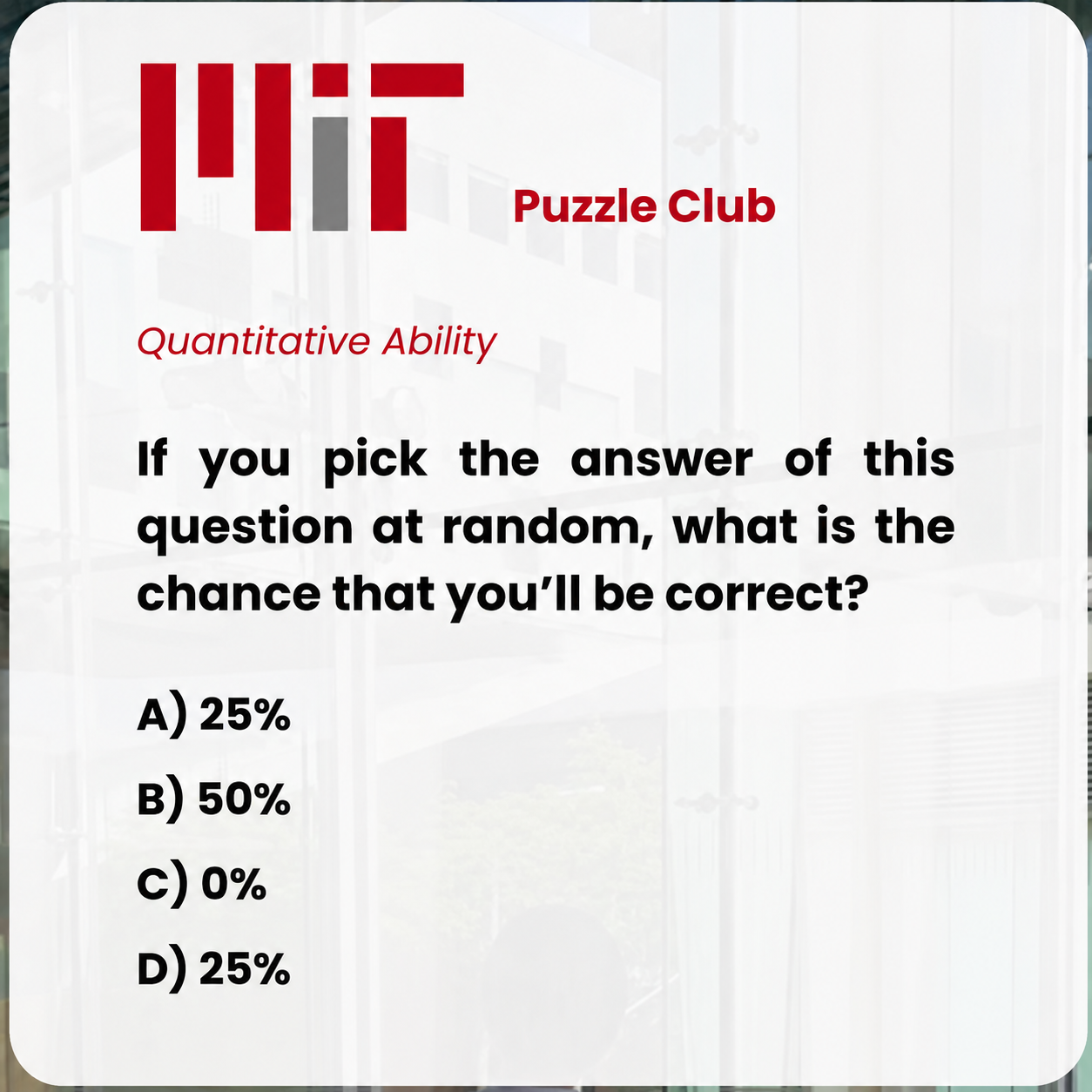
I have seen this maths puzzle circulating on the internet for the umpteenth time. It gets a little boring at this point.
But perhaps this is the first time you’ve come across it through our blog.
At first glance, it looks almost insultingly simple. There are four multiple-choice answers, so your brain immediately starts reaching for elementary probability. Surely this is just a warm-up question.
Before long, you notice something odd. So what’s going on?
Once again, this is a good moment to pause the article and give the problem a go yourself. When you’re ready, keep reading for the solution. And if you come up with your own approach, feel free to share it in the comments — I’d love to see how you tackled it.
Don’t forget to subscribe to our YouTube channel for more maths puzzles, it’s my goal to reach 100k subscribers someday.
Suppose the correct probability is 25%
There are two answers that say 25% (A and D).
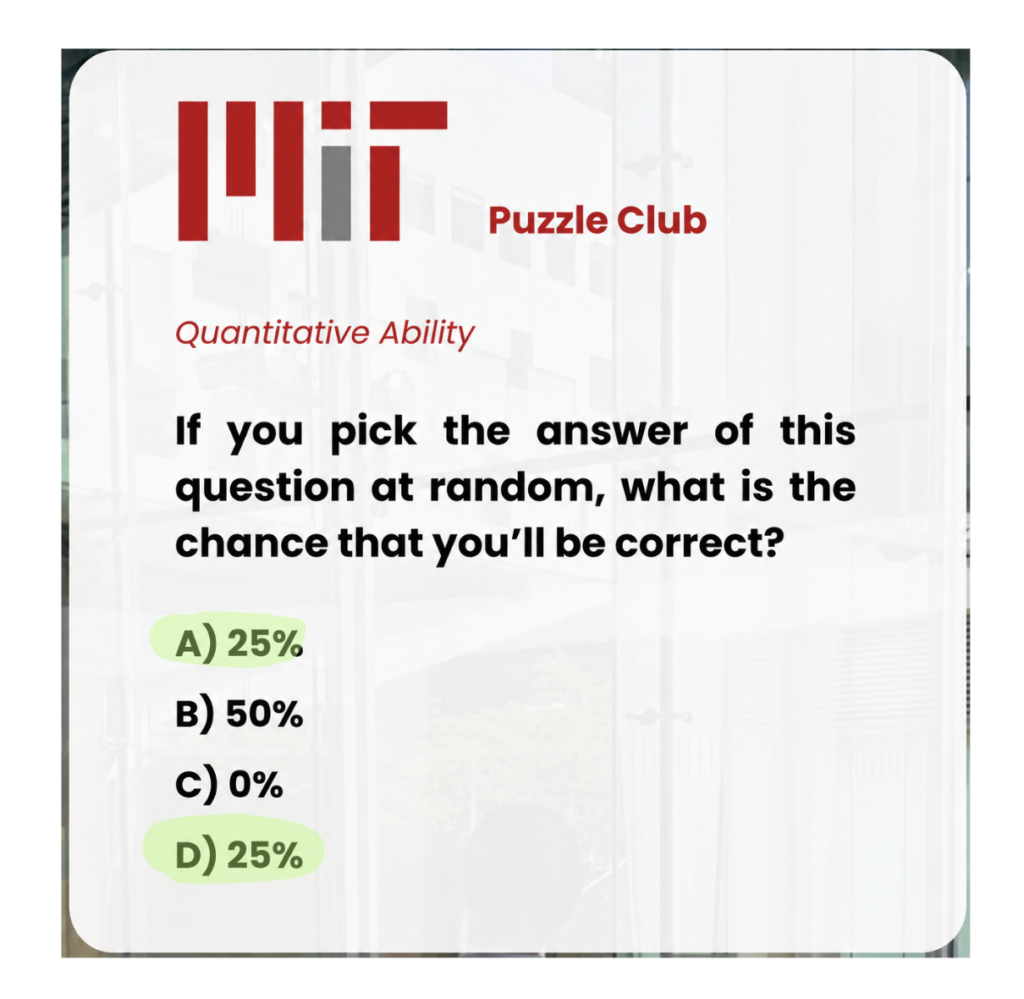
If 25% were the correct probability, then there would be 2 correct answers out of 4, so choosing randomly would give you
2/4 = 50%
not 25%.
So 25% cannot be correct.
Suppose the correct probability is 50%.
Only one answer says 50% (B).
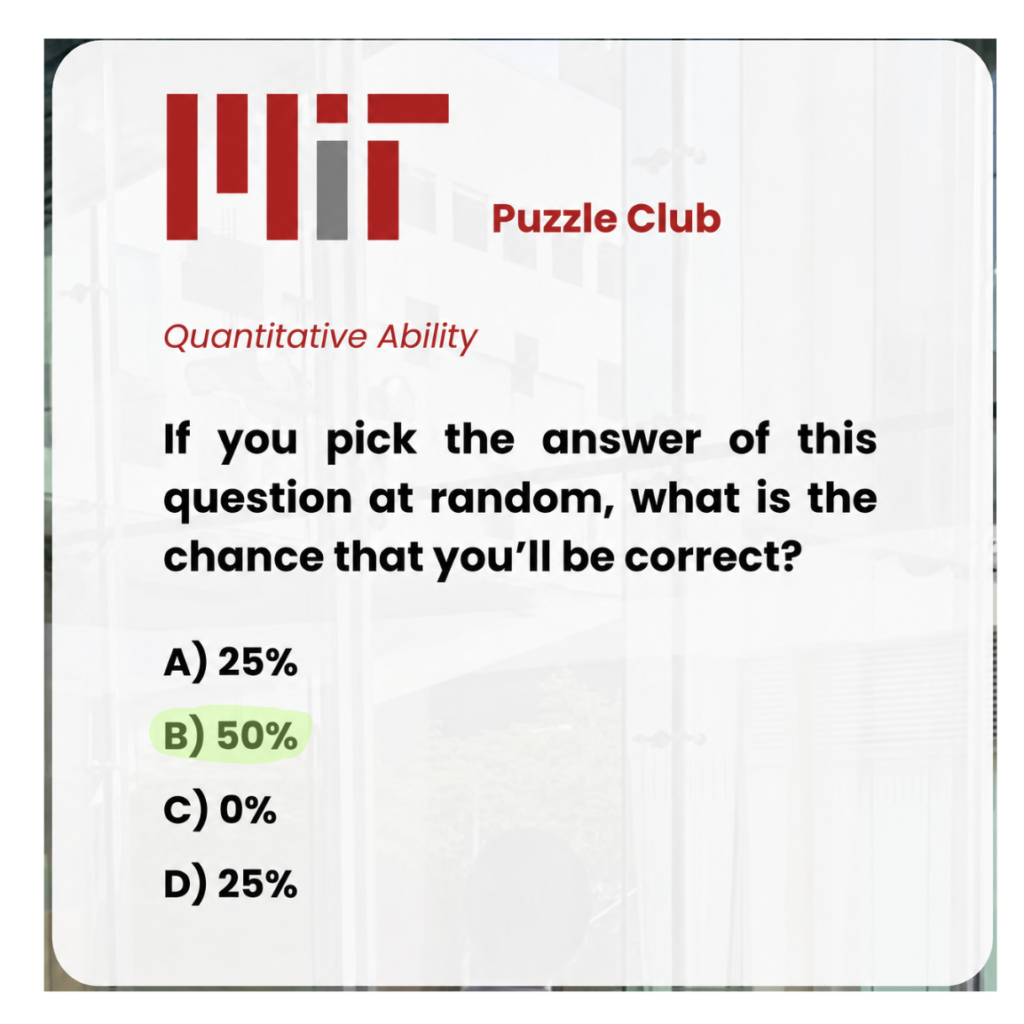
If B were correct, then there would be 1 correct answer out of 4, so the probability of choosing correctly would actually be
1/4 = 25%
not 50%.
So 50% cannot be correct.
Suppose the correct probability is 0%.
If 0% were correct, then C would be the correct answer.
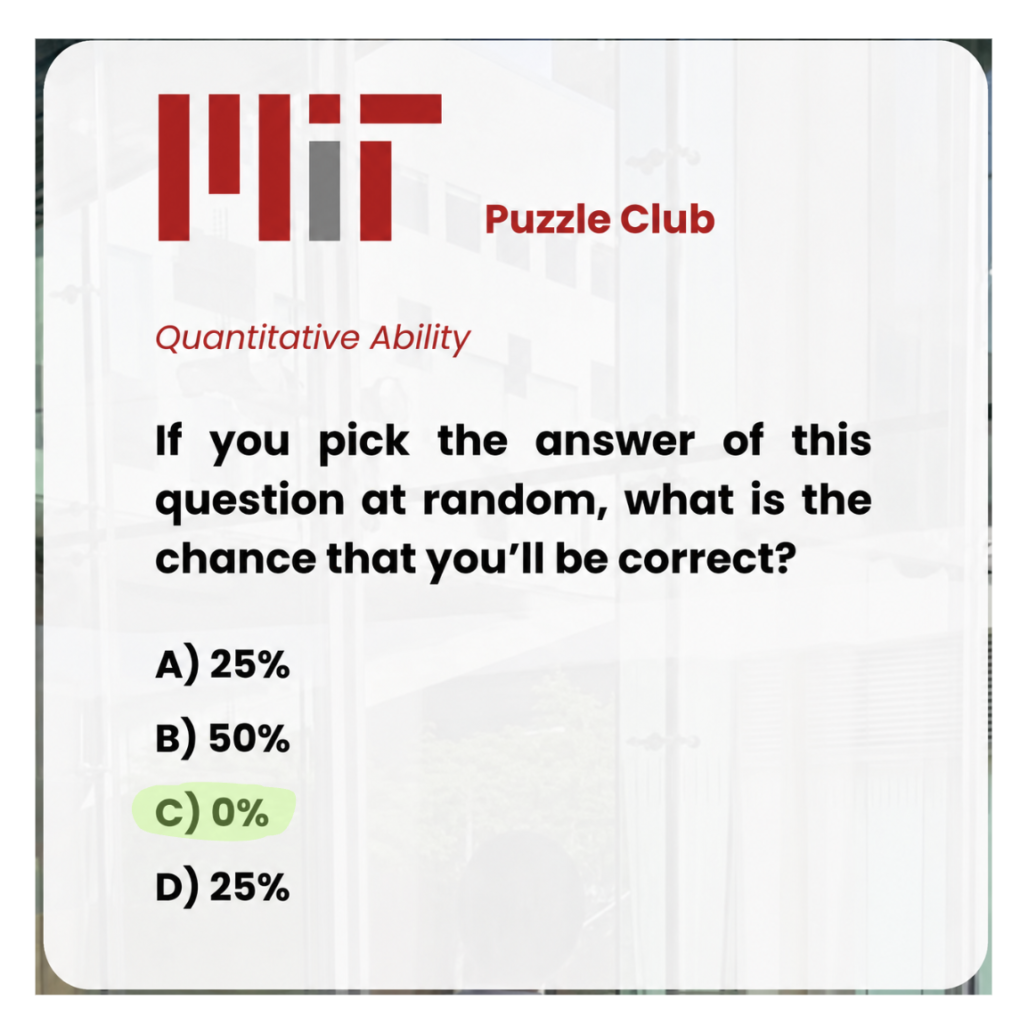
But then there is a correct answer, so choosing at random has a
1/4 = 25%
chance of success, not 0%.
So 0% cannot be correct.
Conclusion
We see that 25% leads to 50%, 50% leads to 25%, and 0% leads to 25%.
Clearly, every answer contradicts itself. Therefore, none of the options is correct.
This makes the puzzle self-referential in the same spirit as the liar paradox (“This statement is false.”). It isn’t really a probability question—it’s a logical consistency puzzle. The multiple occurrences of 25% are what create the paradox.
So what do you think? Let me know!
And that’s our answer. How amazing. Hey, don’t forget to clap👏 the article as a token of appreciation. Thank you 🦁