
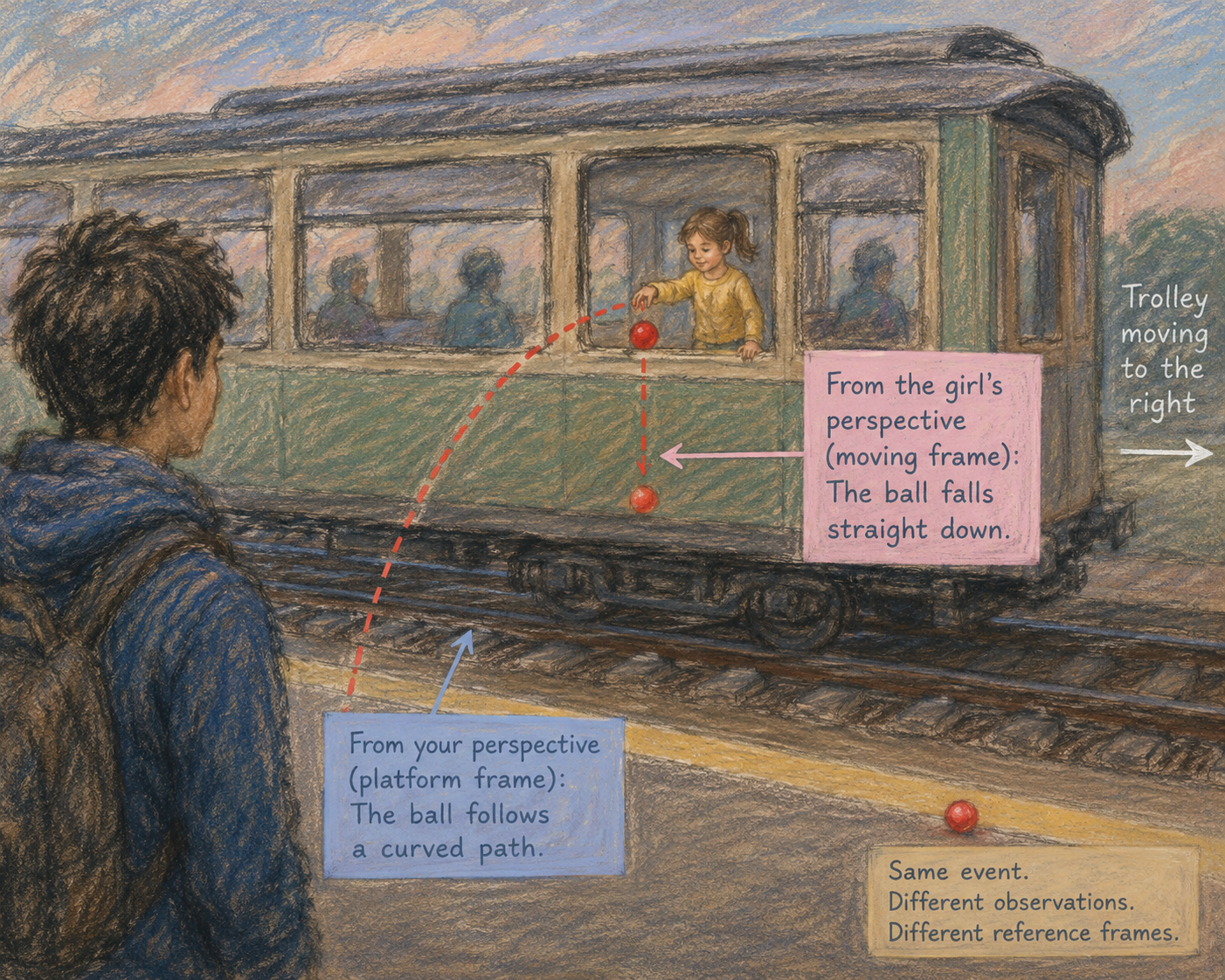
Picture yourself standing on a railway platform as a trolley rolls by. A young girl riding inside lets go of a bright red ball. From her perspective, the ball simply drops straight to the floor. But from where you stand, the ball traces a graceful arc before it lands. You are both watching the very same event, yet each of you describes its motion differently because you are observing it from different reference frames. One frame moves with the trolley, while the other remains fixed to the platform.
Reference frames have been a cornerstone of physics for centuries. Galileo, Isaac Newton, and later Albert Einstein all relied on them to understand motion. In essence, a reference frame is a coordinate system that assigns positions and times relative to a chosen origin. That frame does not have to remain still. It can move as well. Einstein built his theory of relativity on this simple idea, revealing that space and time are not rigid stages on which the universe unfolds. Instead, they are flexible and can bend, stretch, and warp under the influence of matter and energy.
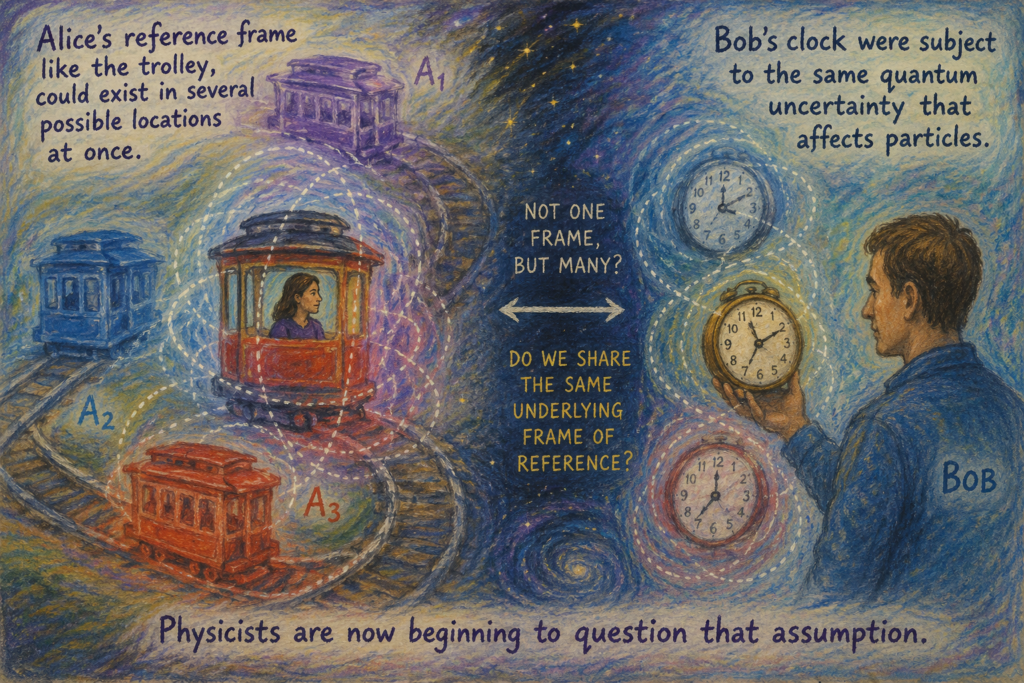
Quantum mechanics, however, has traditionally treated reference frames quite differently. In countless thought experiments, fictional observers such as Alice and Bob may stand in different places, but they are usually assumed to share the same underlying frame of reference. Physicists are now beginning to question that assumption. What if Alice’s reference frame, like the trolley itself, could exist in several possible locations at once? What if Bob’s clock were subject to the same quantum uncertainty that affects particles? These questions are opening an entirely new way of thinking about the foundations of quantum theory.
“If everything else in the quantum world obeys the laws of quantum mechanics, then reference frames should too,” said Renato Renner, a theoretical physicist at the Swiss Federal Institute of Technology Zurich.
That idea is beginning to reshape the field. In a recent paper, the physicist Časlav Brukner of the Institute for Quantum Optics and Quantum Information and the University of Vienna, together with his collaborators, showed that treating reference frames as quantum objects offers a fresh way to understand familiar phenomena such as superposition and entanglement. The work suggests that some of quantum mechanics’ oldest mysteries may look very different when viewed from a quantum reference frame. Renner even believes this approach could help untangle several of the paradoxes that have puzzled physicists for decades.
Brukner and his collaborators have even bigger ambitions. They hope that rethinking physics through the lens of quantum reference frames could provide fresh clues about quantum gravity, the long-standing effort to unify gravity with the other fundamental forces into a single quantum framework.
For Renner, this line of research feels like the start of an entirely new chapter in physics. “We are only at the beginning of something very big,” he said.
Fuzzy Locations
The idea of quantum reference frames is not entirely new. It was first proposed in 1984, but attracted relatively little attention until around 2019, when several research groups independently revived the concept. Since then, interest has grown rapidly. At the heart of this new perspective are two of quantum mechanics’ most famous ideas: superposition, where an object can exist in several possible states at once, and entanglement, where two particles become so deeply connected that measuring one instantly determines the state of the other, even if they are separated by vast distances.
To see why quantum reference frames are so intriguing, imagine two observers with different reference frames, which we’ll call A and B. Suppose the origin of A’s coordinate system is attached to a quantum particle whose position is uncertain. From B’s perspective, A is no longer located at a single point. Instead, A appears spread across several possible positions. Yet if you switch perspectives and stand in A’s frame, the situation reverses. A sees itself as stationary, while B becomes the object whose position is uncertain. In other words, what looks like a superposition depends on which reference frame you choose.
The story becomes even stranger if B is also attached to a quantum object with an uncertain position. Now each observer’s description depends on the possible locations of the other. The two reference frames become linked, so that learning the quantum state of one immediately tells you something about the other. In the language of quantum mechanics, A and B have become entangled. Even the very coordinate systems used to describe reality can share quantum correlations.
The implications run deeper than they first appear. In this picture, two of quantum mechanics’ defining features, superposition and entanglement, are no longer absolute properties. Instead, they can depend on the reference frame from which the system is described. As Anne-Catherine de la Hamette, a co-author of the recent study, explains, many of the properties we usually regard as fundamental are actually relational. Their meaning depends on the observer’s perspective.
The same surprising idea extends to the order of events. Imagine a detector registering a click. In one reference frame, that click may occur at a perfectly well-defined moment. Yet from another quantum reference frame, the very same click could exist in a superposition of occurring both before and after another event. What seems like a fixed sequence of events from one perspective can become fundamentally uncertain from another. In the quantum world, even the timeline itself can depend on where you are looking from.
A Stepping Stone Toward Quantum Gravity
One of the biggest motivations behind quantum reference frames is the hope that they could shed light on one of physics’ greatest unsolved problems: quantum gravity.
Einstein’s theory of general relativity describes gravity as the curvature of space-time caused by mass. The theory works remarkably well on large scales, but it runs into trouble when quantum mechanics enters the picture. What happens if the massive object creating the gravitational field is itself in a superposition of two different locations? Traditional physics has no clear answer. As Viktoria Kabel, a researcher in Brukner’s group and co-author of the recent paper, explains, this is a question that standard approaches to gravity and quantum mechanics struggle to address.
Quantum reference frames offer a possible way forward. By choosing a reference frame whose origin is itself in a superposition, the massive object can appear to occupy a single, well-defined position. Once viewed from that perspective, physicists can calculate its gravitational field using the familiar tools they already have. Rather than inventing entirely new mathematics, the problem is transformed into one that existing physics knows how to solve. As Kabel puts it, the right quantum reference frame can turn an impossible calculation into a manageable one.
The framework could soon prove valuable in real experiments as well. Several proposals aim to place tiny masses into quantum superpositions and observe how their gravitational fields behave. One particularly intriguing idea, put forward by physicists Chiara Marletto and Vlatko Vedral at the University of Oxford, would place two small masses in superpositions of different locations before examining how they gravitationally influence one another. Quantum reference frames may provide the mathematical language needed to interpret these experiments, bringing physicists one step closer to understanding how gravity behaves in the quantum realm.
Renato Renner believes the implications extend even further. He suspects quantum reference frames could help resolve some of the deepest conceptual puzzles in quantum mechanics itself.
A few years ago, Renner and his collaborator Daniela Frauchiger devised a famous thought experiment that appeared to expose a logical contradiction within quantum theory. The paradox suggested that at least one of our most fundamental assumptions must be wrong, perhaps even the idea that quantum mechanics applies universally, from tiny atoms all the way up to human observers.
Today, Renner is not so sure that the contradiction is real. Instead, he believes it may arise because physicists have overlooked an important ingredient: the role of the reference frame itself. Although no one has yet reformulated these famous paradoxes using quantum reference frames, he suspects that doing so could dissolve many of the apparent contradictions. If he is right, changing our perspective may not simply clarify quantum mechanics. It may reveal that some of its greatest mysteries were artifacts of the way we chose to describe the universe in the first place.
The path forward will not be simple. Quantum reference frames still come with many unanswered questions. In ordinary physics, switching between reference frames is straightforward and reversible. If you change your perspective from one frame to another, you can always transform back and recover your original description of the world. Whether the same principle holds for quantum reference frames remains an open question.
Another challenge is that physicists have yet to agree on a universal framework for describing and converting between quantum reference frames. Different research groups have developed their own mathematical approaches. At first glance, many of these methods appear convincing, but they do not always produce the same results. As Renner points out, “they all look reasonable at first sight, but they are not equivalent to each other.”
Despite these difficulties, the potential payoff is enormous. Quantum reference frames may eventually become a crucial tool for understanding the strange foundations of quantum mechanics, revealing that the way we observe reality is not just a matter of perspective, but a fundamental part of the physics itself.